
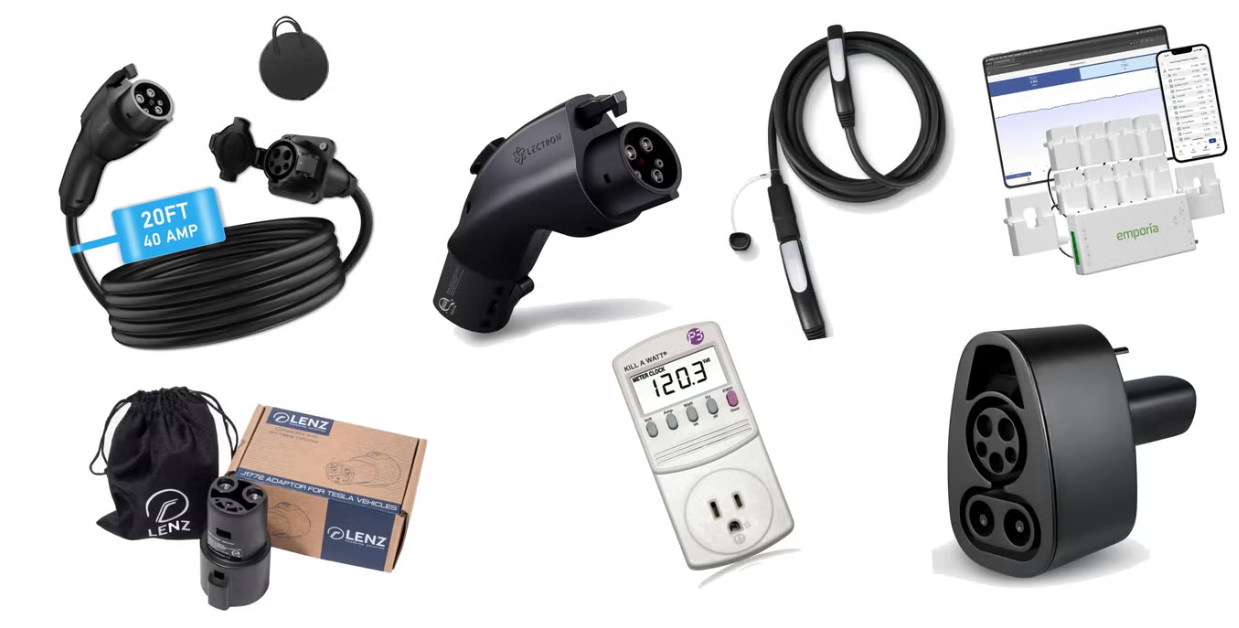
EV charging adapters can help drivers connect an electric vehicle to compatible charging equipment that uses a different connector. They are useful when a public charging station has a different connector from your vehicle or when a driver needs to access an additional charging network.
However, not every adapter works with every electric vehicle. An adapter designed for AC Level 2 charging may be unsuitable for DC fast charging, and a connector that physically fits does not guarantee that the vehicle, adapter, and charging station are compatible.
This guide explains the main types of EV charging adapters, how they work with Tesla and other electric vehicles, what power limits to check, and how to choose and use an adapter safely in the United States.
What Is an EV Charging Adapter?
An EV charging adapter is a hardware device that connects two otherwise incompatible charging connectors. It can allow a vehicle to use certain charging equipment that would not connect directly to its charging port.
For example, a Tesla owner may use an appropriate adapter to connect to a public AC charging station with a J1772 connector. A driver of a compatible CCS1 vehicle may use a manufacturer-approved NACS DC fast-charging adapter to access designated NACS fast-charging stations.
An adapter does not automatically make every charger compatible with every vehicle. Compatibility can depend on the connector standard, charging method, electrical ratings, vehicle software, network access, and manufacturer approval.
Adapter vs. Connector vs. Charger
These terms describe different parts of a charging system.
- Connector: The plug that connects to the vehicle’s charging inlet.
- Charging inlet: The port on the vehicle that accepts a compatible connector.
- Adapter: A device that joins compatible equipment with different connector interfaces.
- EV charger or EVSE: The equipment that supplies and manages electricity for charging.
- Charging network: The service that operates or provides access to public charging stations.
Understanding these differences helps you identify whether you need an adapter, a different charging cable, an appropriate charging unit, or access to another charging network.
Types of EV Charging Adapters
The first step when choosing an adapter is to identify the charging equipment you want to use and the connector on your vehicle. The direction of the connection matters, especially when comparing AC and DC charging accessories.
| Adapter type | Typical application | Important limitation |
|---|---|---|
| J1772-to-NACS AC adapter | Connect compatible J1772 Level 2 charging equipment to a vehicle with a NACS inlet | Must support the vehicle and the intended AC charging rating |
| NACS-to-J1772 AC adapter | Connect compatible NACS AC charging equipment to a vehicle with a J1772 inlet | Must be explicitly approved for the charging equipment and vehicle |
| NACS DC-to-CCS1 adapter | Let an eligible CCS1 vehicle use designated NACS DC fast chargers | Requires vehicle and charging-network support; not for AC charging |
| CCS1 DC-to-NACS adapter | Let an eligible NACS vehicle use compatible CCS1 DC fast chargers | Must be approved for the particular vehicle and charging application |
| Other legacy-standard adapters | Support particular older vehicles or charging installations | Availability and compatibility can be limited and model-specific |
Adapter names are not always used consistently by retailers. Before ordering, confirm which connector is on the charging station or cable and which inlet is on the vehicle. Product images alone are not enough to establish compatibility.
AC Charging Adapters
AC charging is commonly used for home charging, workplace charging, and public Level 2 stations.
In North America, J1772 has been widely used for AC charging. SAE J3400, associated with NACS, also supports AC charging.
An AC adapter may connect a compatible J1772 charging connector to a NACS-equipped vehicle, or connect suitable NACS AC equipment to a vehicle with a J1772 inlet.
For example, Tesla documents that its SAE J1772 charging adapter supports compatible Level 2 public charging stations. This illustrates how the adapter allows a Tesla vehicle to connect to certain non-Tesla AC chargers. See the Tesla J1772 charging adapter documentation.
AC adapters are not DC fast-charging adapters. Their approved use, connector arrangement, voltage and current limits must match the charging equipment and vehicle.
DC Fast-Charging Adapters
DC fast-charging adapters are designed for compatible direct-current charging systems.
One example is a manufacturer-approved NACS DC adapter that enables certain vehicles with a CCS1 inlet to connect to eligible NACS fast chargers. Ford’s official NACS fast-charging adapter documentation, for instance, specifies that its adapter is intended for compatible DC fast-charging stations and is not compatible with Level 1 or Level 2 AC chargers.
An NACS-equipped vehicle may also use an approved CCS1 DC adapter at compatible CCS1 fast chargers if its manufacturer supports that adapter and use case.
These adapters may carry substantial electrical loads. Their safety, power rating, communication compatibility, and approval for the intended vehicle and charging network are essential.
Do not choose a DC adapter solely because the connector shape matches your car.
EV Charging Adapters for Tesla
Tesla charging compatibility is one of the most common reasons drivers search for an EV charging adapter. The right choice depends on whether the driver wants to use a home charger, a public AC charger, a destination charger, or a DC fast-charging station.
Tesla and J1772 AC Charging
Tesla vehicles can use compatible public J1772 Level 2 charging equipment with the appropriate AC adapter. Tesla documents its J1772 adapter as compatible with its vehicles for this purpose.
This can be useful at workplaces, public parking facilities, hotels, and other destinations where J1772 chargers are available.
The vehicle’s maximum AC charging capability and the station’s available output still determine charging speed.
Tesla and NACS/J3400 Equipment
NACS is the common name associated with the SAE J3400 charging connector standard. It supports AC and DC charging through a single connector design, but the charging application and equipment still have to be compatible.
Many Tesla home charging products use the NACS connector. Other EVs may need a manufacturer-approved AC adapter or compatible charging equipment to use a NACS home charger.
Do not assume that a DC fast-charging adapter can be used with a home NACS charger. The Ford NACS fast-charging adapter, for example, is explicitly not intended for Level 1 or Level 2 AC charging.
Using Tesla Superchargers With Non-Tesla EVs
Certain Tesla Superchargers are available to compatible non-Tesla vehicles, but access is not universal across every station or model.
Tesla identifies three types of Supercharger locations:
- Tesla-only locations.
- Locations with a built-in Magic Dock adapter for compatible non-Tesla vehicles.
- NACS locations that support eligible vehicles using an approved NACS DC adapter or a native NACS charging port.
Access for non-Tesla vehicles depends on the manufacturer, vehicle, station, and adapter. Tesla directs drivers to check vehicle eligibility and compatible locations through its official Supercharging guidance.
Tesla also states that unsupported third-party adapters are prohibited at its Supercharger sites. Always follow the requirements of both the vehicle manufacturer and the charging network.
How to Check EV Charging Adapter Compatibility
Before buying or using an EV charging adapter, confirm the following details.
1. Identify the Vehicle’s Charging Inlet
Determine whether your vehicle uses J1772, NACS/J3400, CCS1, CHAdeMO, or another supported connector arrangement.
Check the exact make, model, model year, and configuration. Connector adoption can change across model years, even within the same vehicle family.
2. Identify the Charging Station Connector
Determine which connector is attached to the charging cable or installed at the station.
A home Level 2 charger and a public DC fast charger may use different connector types and charging methods. The adapter must be designed for the actual connection you intend to make.
3. Confirm the Charging Method
Check whether the intended session uses AC or DC.
This is one of the most important compatibility checks because AC and DC adapters are not interchangeable simply because they may use related connector standards.
For example, a CCS1-to-NACS DC fast-charging adapter does not automatically allow an EV with a CCS1 inlet to use a NACS home AC charger.
4. Verify Manufacturer Approval
Confirm that the adapter is explicitly supported for your vehicle and the intended charging equipment.
The U.S. Joint Office of Energy and Transportation advises drivers to use adapters provided by their vehicle manufacturer for the specific vehicle and application, following the manufacturer’s instructions.
The Joint Office identifies UL 2252 as the relevant adapter safety standard, and UL Solutions describes it as a standard for evaluating EV charging adapter safety, performance, and compatibility. See the Joint Office adapter compatibility guidance and UL Solutions adapter certification information.
5. Check Network Access
Physical compatibility does not automatically provide access to a public charging network.
Some stations require the vehicle to be eligible for the network, the session to be started through an app, or the adapter to be recognized through supported vehicle and charger communications.
Verify network access before relying on an adapter for a road trip.
EV Charging Adapter Power Limits
An adapter does not increase the maximum charging power that your vehicle or charger can support.
The usable charging rate is limited by the capabilities and operating conditions of the vehicle, adapter, cable, charging station, and electrical supply.
A high-current adapter rating does not mean your car will receive that current. Your vehicle may have a lower charging limit, the station may provide less power than its advertised maximum, or the charging system may reduce power because of temperature or battery conditions.
For example, Ford lists its NACS DC fast-charging adapter as rated for up to 500 amps and 1,000 volts. That is a rating for the adapter’s specified application, not a promise that every vehicle will charge at those values.
Before purchase, check these ratings:
- Maximum voltage.
- Maximum current.
- Supported charging standard.
- AC or DC application.
- Approved vehicle compatibility.
- Environmental and temperature limitations.
Do not use an adapter beyond its rated limits or combine adapters unless the manufacturer explicitly approves the arrangement.
How to Use an EV Charging Adapter Safely
EV charging adapters handle electrical connections that may carry substantial power for an extended period. Following the manufacturer’s instructions is essential.
Inspect the Adapter Before Use
Look for cracks, deformation, discoloration, damaged contacts, loose components, or other visible signs of wear. Do not use an adapter that appears damaged or has previously shown signs of overheating.
Check that the adapter and charging connectors are clean and dry where required by the manufacturer’s instructions.
Follow the Correct Connection Sequence
The correct sequence can vary by adapter and charging system. Follow the vehicle and charging-network instructions rather than assuming that every adapter connects in the same order.
At Tesla Supercharger sites, Tesla instructs eligible drivers using a NACS DC adapter to connect the adapter to the charging cable before plugging it into the vehicle. Use the process specified by the operator for the exact equipment.
Do Not Force a Connector
A compatible connector should engage as designed. If it does not fit or lock properly, stop and verify the connector and adapter types.
Never force a plug, bypass a safety mechanism, or modify an adapter to make it fit.
Avoid Unapproved Third-Party Adapters
Use an adapter that is approved for the specific vehicle and charging application. A seller’s claim that an adapter works with a particular connector is not sufficient proof of safety or compatibility.
This matters especially for DC fast charging, where electrical loads and thermal demands can be substantial.
Stop if the Adapter Overheats or Reports a Fault
If you notice unusual heat, an electrical smell, visible damage, or persistent fault notifications, stop the charging session according to the vehicle and station instructions. Do not continue using the adapter until the issue has been assessed.
For general safety guidance, the U.S. Fire Administration recommends certified EV charging equipment and following the manufacturer’s charging instructions. See its electric vehicle fire safety guidance.
What to Look for When Buying an EV Charging Adapter
A good purchasing decision starts with compatibility, not price.
| Buying criterion | What to check |
|---|---|
| Connector configuration | Confirm the station-side connector and vehicle-side inlet |
| Charging method | Verify AC Level 1/Level 2 or DC fast charging |
| Electrical ratings | Check supported voltage and current |
| Vehicle compatibility | Confirm the exact model year and manufacturer approval |
| Charging-network compatibility | Check whether the intended network supports the vehicle and adapter |
| Safety certification | Verify applicable listings or certification for the exact product |
| Environmental suitability | Check weather, temperature, and enclosure requirements |
| Warranty and support | Review coverage, exclusions, replacement procedures, and support channels |
| Return policy | Ensure the adapter can be returned if compatibility differs from the product description |
Should You Buy the Cheapest Adapter?
Not necessarily. An adapter that costs less but lacks clear manufacturer approval or verified safety certification may introduce unnecessary risk.
Compare the full technical specifications and exact compatibility information. For DC fast-charging adapters, pay particular attention to the manufacturer-approved vehicle list and network restrictions.
Also avoid assuming that all products marketed as “NACS adapters” serve the same purpose. The phrase may refer to an AC charging adapter, a DC fast-charging adapter, or a particular connector arrangement. Read the documentation carefully.
Frequently Asked Questions About EV Charging Adapters
Are all EV charging adapters universal?
No. Compatibility depends on the connector standards, charging method, voltage and current ratings, vehicle, charger, and applicable network requirements. A universal-sounding product description does not establish compatibility with every EV.
What adapter do I need to use a public Level 2 charger with a Tesla?
Tesla vehicles can use compatible public J1772 Level 2 charging stations with an appropriate SAE J1772 adapter. Check the vehicle’s supplied equipment and Tesla’s official guidance before purchasing an additional adapter.
Can I use a NACS adapter at any Tesla Supercharger?
No. Supercharger access depends on the station type, vehicle eligibility, approved adapter, and network requirements. Tesla-only sites, Magic Dock locations, and compatible NACS locations have different access arrangements.
Can I use a DC fast-charging adapter for home charging?
Not unless the adapter is explicitly designed and approved for that home charging application. DC fast-charging adapters are not interchangeable with AC Level 1 or Level 2 adapters.
Do EV charging adapters reduce charging speed?
An adapter does not automatically reduce charging speed, but the session is limited by the capabilities of the vehicle, adapter, charging equipment, and electrical supply. The rating of the least-capable applicable component may limit the usable power.
Is UL 2252 certification important?
UL 2252 is a relevant standard for evaluating EV charging adapter safety, performance, and interoperability. Verify certification for the exact product rather than relying only on general marketing claims.
Can I use two adapters together?
Do not combine adapters unless the vehicle, adapter, and charging equipment manufacturers explicitly approve the arrangement. Stacking adapters can introduce unsupported electrical and mechanical connections.
Final Thoughts: Choose EV Charging Adapters by Application
EV charging adapters can expand the charging options available to an electric vehicle owner, particularly as the U.S. market transitions toward SAE J3400/NACS alongside established standards such as J1772 and CCS1.
The important decision is not simply which plug fits your car. You must match the charging method, connector direction, electrical ratings, vehicle eligibility, network access, and safety requirements.
Before buying an adapter, verify the exact vehicle and charging station, check manufacturer approval, and review the applicable safety certification. This is especially important for DC fast-charging equipment and public charging networks with specific access rules.
When compatibility is established before purchase, an EV charging adapter can provide useful flexibility without relying on guesswork.
Sources and Further Reading
- Joint Office of Energy and Transportation — Connector and Adapter Compatibility
- Joint Office — SAE J3400 Charging Connector
- UL Solutions — EV Charging Adapter Testing and Certification
- Tesla — Supercharging Other EVs
- Tesla — SAE J1772 Charging Adapter
- Ford — NACS Fast-Charging Adapter
- U.S. Department of Energy — Electric Vehicles for Consumers
- U.S. Fire Administration — Electric Vehicle Fire Safety