
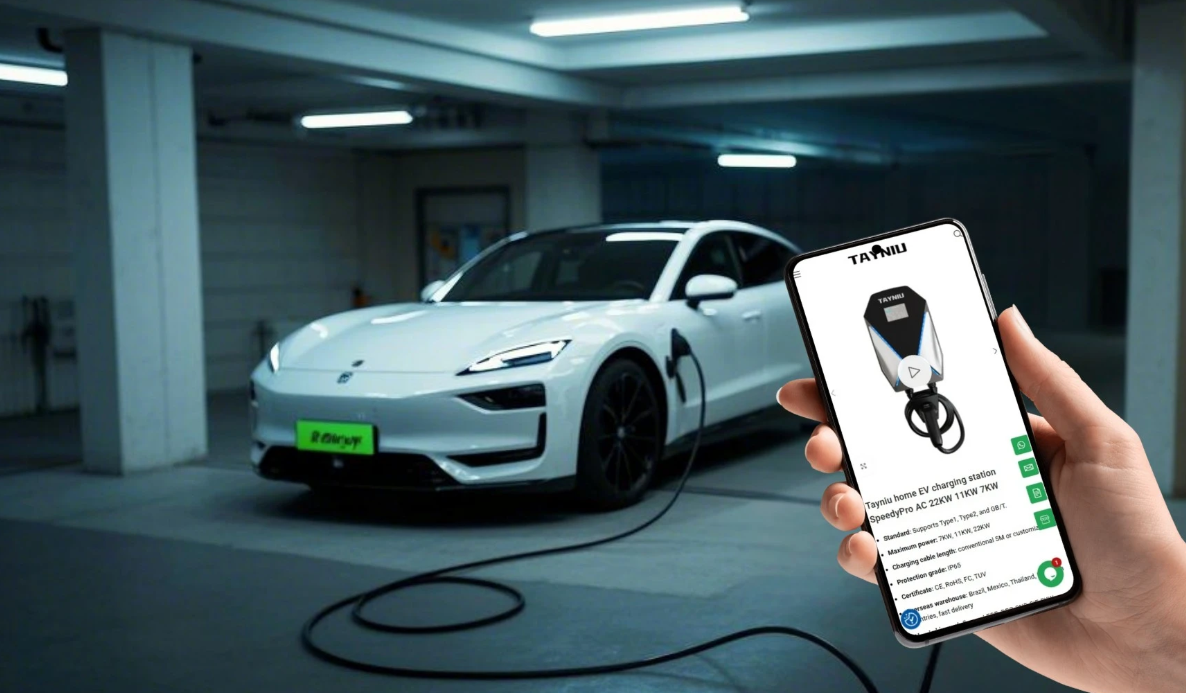
Home EV charging vs. public charging is an important consideration for anyone who owns or plans to buy an electric vehicle. Charging at home is often cheaper and more convenient for everyday driving, while public charging provides flexibility for people who cannot charge at home or need to recharge during longer trips.
The best option depends on where you park, how far you drive, your local electricity rates, and how quickly you need to recharge. Some drivers can meet nearly all their needs with a home charging station, while others rely on a combination of home, workplace, and public charging.
In the United States, home charging typically uses Level 1 or Level 2 equipment. Public charging stations commonly offer Level 2 charging and DC fast charging, which can replenish a compatible electric vehicle much faster.
Understanding the differences in cost, charging speed, installation requirements, and convenience can help you choose the most practical charging strategy for your daily routine.
Home EV Charging vs. Public Charging at a Glance
Home charging allows you to recharge your vehicle at your residence using electricity from your household supply. Public charging uses equipment available at locations such as shopping centers, parking garages, workplaces, hotels, and highway rest stops.
Here are the main differences.
| Factor | Home charging | Public charging |
|---|---|---|
| Convenience | Charge while parked at home, often overnight | Requires traveling to an available charging station |
| Typical charging options | Level 1 and Level 2 | Level 2 and DC fast charging |
| Electricity cost | Usually based on your residential utility rate | Set by the charging provider or site operator |
| Equipment cost | May require purchasing a home charger | No personal charger purchase is usually necessary |
| Installation | Level 2 may require a new circuit and professional installation | No installation is required at the driver’s property |
| Charging speed | Level 1 is slow; Level 2 is suitable for overnight charging | Level 2 is similar in principle to home Level 2; DC fast charging is substantially faster |
| Availability | Depends on access to a suitable parking space and electrical supply | Depends on station location, operating condition, and demand |
| Best use | Regular daily charging | Road trips, apartment living, and charging away from home |
Neither option is ideal for every driver. Home charging is convenient when you have a suitable parking space and electrical access. Public charging is essential for many drivers who cannot install a charger at home and remains useful even for homeowners on longer journeys.
Is Home EV Charging Cheaper Than Public Charging?
For many EV owners in the United States, home charging costs less per kilowatt-hour than public charging, particularly public DC fast charging. However, the difference depends on your utility rate, the charging network, the location, and any subscription or session fees.
The U.S. Energy Information Administration (EIA) reported an average US residential electricity price of 17.23 cents per kilowatt-hour in 2025.
By comparison, AAA’s EV charging price tracker reported a national average of approximately $0.42 per kWh for commercial and public charging on October 23, 2026. Its figure combines public Level 1, Level 2, and Level 3/DC fast charging, so it is not a specific price for every network or charging speed.
These figures cover different reporting periods and pricing categories, but they illustrate why home charging can offer a cost advantage.
Example: What Does It Cost to Charge 30 kWh?
Suppose an electric vehicle uses 30 kWh of billed charging electricity. Using the rates above, the energy cost would be approximately:
| Charging method | Example rate | Cost for 30 kWh |
|---|---|---|
| Home charging at the 2025 US residential average | $0.1723/kWh | $5.17 |
| Public charging at AAA’s October 23, 2026 average | $0.42/kWh | $12.60 |
These are illustrative calculations, not guaranteed prices. Your actual cost depends on your utility tariff, charging provider, vehicle efficiency, and charging losses.
The example also excludes any one-time expense for installing a home charger. That matters because a home charging station may require an upfront investment before you can benefit from lower electricity costs.
Why Is Public Charging Often More Expensive?
Public charging providers must account for expenses such as equipment, installation, electricity supply, maintenance, payment systems, and network operations. The way those costs are recovered depends on the operator and location.
Public charging prices may be calculated in several ways:
- Per kilowatt-hour: You pay for the amount of electricity delivered.
- Per minute: Your cost depends on how long you occupy the charger.
- Per session: A fixed fee may apply when you start charging.
- Subscription or membership: A plan may offer lower rates for eligible users.
- Parking or idle fees: Separate charges may apply for parking or remaining connected after charging finishes.
Some public stations and workplace chargers offer free or subsidized charging. Others charge considerably more than residential electricity rates, especially at DC fast-charging stations.
Always review the price displayed in the charging network’s app or at the station before plugging in.
Is Charging an EV at Home More Convenient?
For drivers who have access to a suitable parking space and electrical supply, home charging is often the most convenient option for everyday use.
Instead of making a separate trip to a charging station, you can plug in when you arrive home and let the vehicle charge while you sleep, work remotely, or go about your normal routine.
Advantages of Home Charging
Charge overnight. You can start each morning with the amount of battery energy your driving routine requires, provided the charging equipment and charging time are sufficient.
Avoid unnecessary stops. Daily charging can take place while the vehicle is already parked, reducing the need to visit a public station.
Control charging schedules. Some vehicles and smart chargers allow you to schedule charging during cheaper electricity periods when your utility offers time-of-use rates.
Use your preferred charging equipment. You can select compatible equipment based on your vehicle, parking space, electrical capacity, and expected charging needs.
The US Department of Energy’s home EV charging guide explains that many drivers can meet their daily driving needs through overnight Level 1 charging, while Level 2 charging is useful for longer commutes, irregular schedules, or vehicles with larger batteries.
Limitations of Home Charging
Home charging is not equally convenient for everyone.
People who rent apartments, live in multifamily buildings, park on the street, or use shared parking may not have direct access to an electrical outlet or dedicated charger.
Installing a Level 2 charger may also require a qualified electrician, a suitable electrical circuit, permits, or upgrades to the home’s electrical system.
If you drive long distances every day and need more energy than your home setup can replenish overnight, you may still need occasional public charging.
When Is Public EV Charging More Convenient?
Public charging is especially useful when charging at home is impractical or when your driving takes you beyond the range available from your current battery charge.
Public charging stations are commonly located near shopping centers, workplaces, hotels, parking facilities, and major travel routes.
Advantages of Public Charging
No home installation required. You can use an available public charging station without purchasing and installing a charger at your property.
Useful for apartment residents. Public charging can provide access to electricity when your building does not offer dedicated EV charging facilities.
Faster charging for road trips. DC fast chargers can replenish a compatible battery much faster than typical home AC charging equipment.
Charge while traveling. Public stations help drivers extend their journeys beyond the range available from a single battery charge.
Multiple charging speeds. Depending on the station, you may have access to Level 2 charging or DC fast charging.
The US Department of Energy provides a public charging station locator through the Alternative Fuels Data Center to help drivers identify stations along their routes.
Limitations of Public Charging
Public charging usually requires more planning than charging at home.
A charger may be occupied, unavailable, temporarily out of service, or located farther away than expected. You may need to wait for another driver to finish charging or visit a different station.
Prices and payment requirements can also differ by provider. Some stations require an app or account, while others support card payments or contactless payment methods.
During road trips, charging time adds to travel time, particularly when you need to stop at several stations or charge during busy periods.
For these reasons, public charging works best when you consider station availability, charging speed, location, and price before arriving.
Home vs. Public Charging Speed: Which Is Faster?
Public charging can be faster than home charging, but the answer depends on which types of chargers you compare.
Level 2 charging is available both at home and in public. DC fast charging, meanwhile, is generally associated with public charging sites and is designed to deliver much more power than a typical residential AC charger.
The US Department of Transportation’s charging-speed guide provides the following general estimates.
| Charging type | Typical power supply | General charging-speed indication |
|---|---|---|
| Level 1 | 120V AC at home | Approximately 2–5 miles of range per hour |
| Level 2 | 240V residential AC or compatible commercial supply | Approximately 10–30 miles of range per hour |
| DC fast charging | High-power DC equipment | Approximately 100–200+ miles of range in 30 minutes |
These figures are broad estimates, not guaranteed results. Actual charging speed depends on the vehicle, battery size, state of charge, temperature, charger output, and the vehicle’s maximum charging capability.
How Fast Is Home Level 1 Charging?
Level 1 charging uses a suitable 120-volt household outlet and compatible charging equipment.
It is the simplest way to start home charging when an appropriate outlet and circuit are available. However, it provides relatively little energy per hour.
For drivers who travel only short distances each day, charging overnight may be sufficient. Drivers with longer commutes may find that Level 1 charging cannot replenish enough energy before the next trip.
How Fast Is Home Level 2 Charging?
Level 2 charging uses a suitable 208- or 240-volt electrical supply. In a US residence, 240 volts is common.
The higher power can replenish more energy while the car is parked overnight, making Level 2 a practical option for many full-electric vehicles.
However, buying a charger with a higher maximum output does not automatically make every vehicle charge faster. The vehicle’s onboard AC charger and the installed circuit limit the power the car can accept.
Why Is Public DC Fast Charging Faster?
DC fast chargers supply direct current to a compatible vehicle’s battery through specialized equipment, bypassing the vehicle’s onboard AC charging conversion process.
This allows suitable vehicles to charge at much higher power levels than typical home chargers can provide.
However, advertised peak power is not the same as the average charging speed across an entire session. Charging power can decrease as the battery fills, and not every vehicle can accept the maximum output advertised by a station.
DC fast charging is therefore particularly useful for longer trips, while home Level 2 charging is often more convenient for routine overnight charging.
What Does It Cost to Install a Home EV Charger?
Unlike public charging, home Level 2 charging may require an upfront equipment and installation expense.
The total depends on the charger’s price, the distance between the electrical panel and the charging location, the home’s available electrical capacity, and local requirements.
Potential costs include:
- Purchasing a compatible Level 2 charging station.
- Installing a dedicated circuit, breaker, and wiring.
- Running conduit or wiring to a garage or outdoor parking space.
- Paying for electrical permits and inspections, where required.
- Upgrading a panel or electrical service if the existing system cannot support the load.
- Additional construction for a detached garage or distant parking space.
The US Department of Energy’s home charging guidance explains that Level 2 equipment has a wide range of equipment costs and that installation can add expenses, especially when electrical service upgrades are necessary.
Not every home needs a major upgrade. Some homes have sufficient capacity for a new charging circuit, while others may need a different charging configuration or an approved load-management solution.
Have a qualified electrician assess your electrical system and provide an itemized quote before purchasing equipment.
Does the Upfront Cost Make Home Charging Less Economical?
It can affect the overall savings, especially if you drive relatively few miles or expect to change homes soon.
To evaluate the economics, compare your estimated annual charging costs with the upfront equipment and installation expense. A driver who charges frequently at home may benefit more from lower residential electricity rates than someone who drives only occasionally and mostly charges at free public stations.
If your home already has a suitable Level 1 outlet and your daily driving needs are modest, you may not need a Level 2 installation at all.
The most economical solution is not necessarily the one with the lowest price per kilowatt-hour. It is the setup that meets your charging needs at a reasonable total cost.
Can You Use Home and Public Charging Together?
Yes. For many EV owners, combining home and public charging is the most practical approach.
Home charging can handle most everyday energy needs, while public stations provide additional flexibility for long trips, unexpected travel, or days when the vehicle consumes more energy than usual.
For example, a driver might charge at home overnight during the workweek and use a public DC fast charger during a weekend road trip.
A driver who lives in an apartment without a charging outlet might rely on public Level 2 charging near work or shopping locations, then use DC fast charging when time is limited or a longer journey requires it.
The best mix depends on where you park, local charger availability, your daily mileage, and the rates offered by your utility and charging networks.
Which EV Charging Option Is Best for Different Drivers?
Your driving routine and access to parking can help determine which charging method makes the most sense.
| Driver situation | Most practical option | Why |
|---|---|---|
| Homeowner with a garage | Home charging | Convenient overnight charging and typically lower energy costs |
| Driver with a short daily commute | Home Level 1 or Level 2 | Level 1 may be enough if the vehicle has sufficient time to charge |
| Driver with a long daily commute | Home Level 2 plus occasional public charging | Faster overnight charging with flexibility for additional energy |
| Apartment resident without charging access | Public or workplace charging | Does not require installing equipment at home |
| Frequent road-trip driver | Home charging plus public DC fast charging | Economical routine charging with faster charging during journeys |
| Driver who cannot install a charger | Public, workplace, or shared residential charging | Provides access to charging without a private installation |
| Driver with very low residential electricity rates | Primarily home charging | Can help minimize energy costs, depending on the local public charging prices |
There is no need to choose one charging option exclusively. The most effective strategy is often to use the most convenient and economical method for each situation.
How to Find Public Charging Stations and Compare Prices
If you expect to depend on public charging, make checking station availability part of your trip planning.
Use a public charging station locator or charging network app to find stations near home, work, shopping areas, and common travel routes.
Before selecting a station, review:
Connector compatibility. Confirm that the connector matches your vehicle or that an approved adapter supports the intended charging application.
Charging speed. Choose Level 2 for longer parking periods or DC fast charging when you need to replenish energy quickly.
Price. Check the per-kWh, per-minute, session, parking, or membership charges that apply.
Availability. Check whether a charging port is listed as available and whether the network reports any outages.
Payment method. Confirm whether you need an account, app, membership, or payment card.
Location and access. Consider opening hours, parking restrictions, and whether the charger is available to the public or restricted to customers or authorized users.
The federal Alternative Fuels Data Center Station Locator is one place to begin researching public charging locations across the United States.
Frequently Asked Questions
Is home EV charging cheaper than public charging?
Home charging is often cheaper because you pay your residential electricity rate rather than a commercial charging price. However, actual savings depend on local electricity rates, public charging tariffs, free charging opportunities, subscription fees, and any upfront cost to install home equipment.
Is public charging faster than home charging?
Public DC fast charging is generally much faster than residential Level 1 or Level 2 charging. Public Level 2 stations operate on the same general charging principle as home Level 2 equipment, although power output varies. Actual speeds depend on the station and vehicle.
Can I own an EV without a home charger?
Yes. Drivers can own an EV without installing a private home charging station, provided they have access to suitable public, workplace, or shared residential charging. Before buying the vehicle, check that charging locations are practical for your routine and that their availability and prices meet your needs.
Is Level 1 home charging enough for everyday driving?
It can be. Level 1 charging may meet the needs of drivers who travel relatively short distances and leave their vehicles parked for many hours. Drivers with longer commutes or larger batteries may prefer Level 2 equipment because it can replenish more energy overnight.
Does public EV charging cost the same at every station?
No. Charging prices vary by network, location, charging speed, membership status, and pricing structure. Some stations offer free or subsidized charging, while others charge per kWh, per minute, or per session. Check the applicable rate before charging.
Should I install a Level 2 charger if I already use public charging?
That depends on your home, driving needs, and costs. A Level 2 charger may provide greater convenience and lower recurring charging costs if you drive frequently and can charge at home. However, installation costs may outweigh the benefits for some low-mileage drivers or people who expect to move soon.
Can I use a home charger for a road trip?
A home charger is designed for charging at your residence, so it is not generally a replacement for public fast-charging infrastructure during road trips. A portable charging cordset may be useful at destinations where a suitable outlet is available, but charging will be much slower than at most DC fast chargers.
Final Thoughts
Home EV charging vs. public charging is not an either-or decision for every electric vehicle owner. Home charging is often the most convenient option for everyday use and can offer lower electricity costs, while public charging provides flexibility when you are away from home or need faster charging on longer journeys.
If you have access to a suitable parking space and electrical supply, home Level 1 or Level 2 charging may cover much of your routine driving. If you live in an apartment or frequently travel long distances, public Level 2 and DC fast charging can play a larger role.
Before deciding, compare your residential electricity rate with the prices at nearby public stations, consider the upfront cost of installing a home charger, and evaluate how much energy your vehicle needs each day.
For many drivers, the best approach is to charge at home whenever it is practical and use public charging when convenience, speed, or travel requirements make it necessary.
Sources and Further Reading
- U.S. Department of Energy: Charging Electric Vehicles at Home
- U.S. Department of Energy: Electric Vehicles for Consumers
- U.S. Department of Energy: Public EV Charging Stations
- U.S. Department of Transportation: Charger Types and Speeds
- U.S. Energy Information Administration: Average Electricity Prices
- AAA: EV Charging Prices