
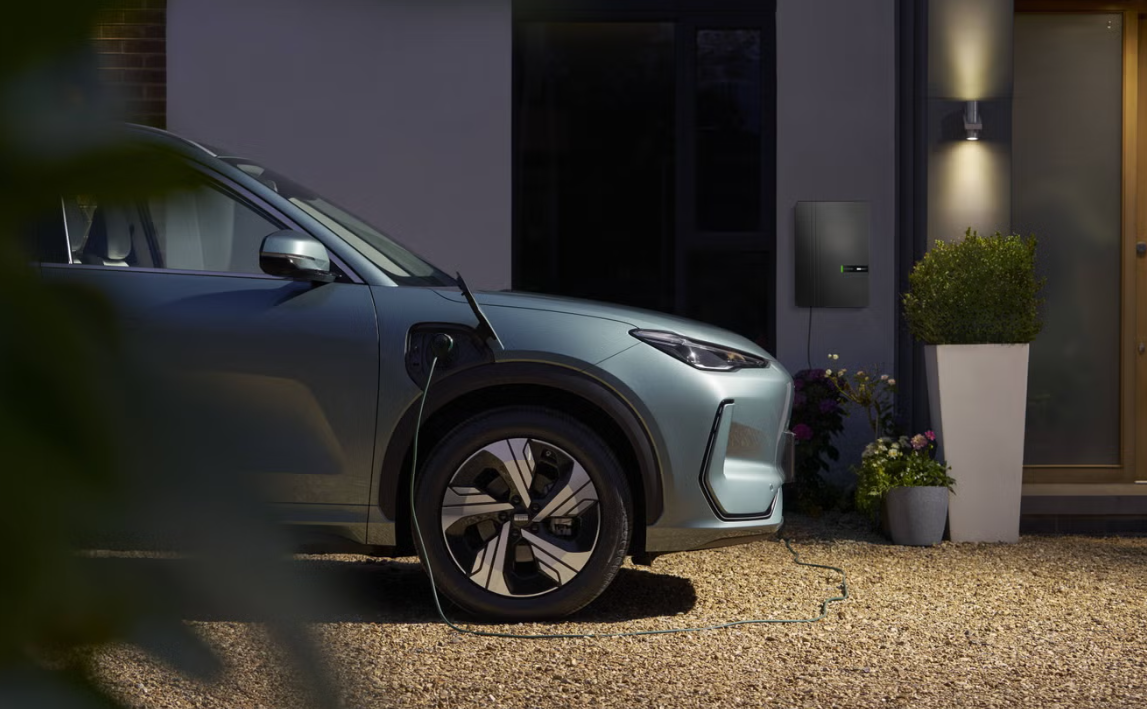
Most electric cars that have a plug-in charging port can be charged at home, including battery-electric vehicles (BEVs) and plug-in hybrid electric vehicles (PHEVs). Depending on the vehicle and your home’s electrical setup, you can charge using a standard 120-volt household outlet or a faster Level 2 charging station connected to a suitable 240-volt circuit.
However, not every vehicle described as a hybrid or electric vehicle can be plugged in. Conventional hybrids use gasoline and recover electricity through regenerative braking, while plug-in hybrids can connect to an external power source to recharge their batteries.
Before choosing an electric vehicle, it is important to understand which types support home charging, how their charging requirements differ, and how to select compatible equipment. The right setup depends on your vehicle’s model year, charging connector, battery size, and daily driving needs.
What Types of Electric Cars Can Be Charged at Home?
There are three main categories of vehicles worth understanding when comparing cars that can be charged at home: battery-electric vehicles, plug-in hybrid electric vehicles, and conventional hybrid electric vehicles.
The key distinction is whether the vehicle can accept electricity from an external charging source.
| Vehicle type | Can charge at home? | Uses gasoline? | Requires a charging port? |
|---|---|---|---|
| Battery-electric vehicle (BEV) | Yes | No | Yes |
| Plug-in hybrid electric vehicle (PHEV) | Yes | Yes | Yes |
| Conventional hybrid electric vehicle (HEV) | No external charging | Yes | No |
| Mild hybrid vehicle | No external charging | Yes | No |
The US Department of Energy’s Alternative Fuels Data Center explains the differences between battery-electric vehicles, plug-in hybrids, and conventional hybrids.
1. Battery-Electric Vehicles (BEVs)
Battery-electric vehicles run entirely on electricity stored in a rechargeable battery. They do not have a gasoline engine, so they must obtain electricity from an external source to replenish their driving energy.
These vehicles are often the main choice for drivers looking for an electric car that can be charged at home.
Examples of battery-electric vehicle models sold in the US market across recent model years include:
- Tesla Model 3
- Tesla Model Y
- Ford Mustang Mach-E
- Chevrolet Equinox EV
- Hyundai IONIQ 5
- Rivian R1S and R1T
This is a representative list, not a guarantee that every trim or model year is currently available. Vehicle availability, charging ports, and specifications can differ by model year and configuration.
BEVs can generally use compatible Level 1 or Level 2 home charging equipment. Level 1 charging may be adequate for drivers with short commutes and long parking periods, while Level 2 equipment is often more practical for vehicles with larger batteries or higher daily mileage.
Best for: Drivers who want to operate entirely on electricity and have access to a suitable home charging location.
2. Plug-In Hybrid Electric Vehicles (PHEVs)
Plug-in hybrid electric vehicles combine a rechargeable battery and electric motor with a gasoline engine.
Unlike conventional hybrids, PHEVs can be connected to an external charging source. They can travel on electric power for a limited distance before using the gasoline engine when additional range is needed.
Examples of plug-in hybrid models offered in recent US model years include the Toyota Prius Plug-in Hybrid and certain plug-in hybrid SUV models. Availability varies by model year, so verify the exact vehicle on the manufacturer’s website or the US Department of Energy vehicle resources.
PHEVs generally have smaller batteries than BEVs, so they often require less energy to recharge. Many can use Level 1 charging overnight, while Level 2 charging can shorten the time required.
However, a PHEV still needs gasoline for trips when its electric driving range is insufficient. Regular charging helps you use more of its electric capability and reduce gasoline consumption.
Best for: Drivers who want electric commuting capability but prefer a gasoline engine for longer journeys.
3. Conventional Hybrid Vehicles (HEVs)
A conventional hybrid combines a gasoline engine with an electric motor and a battery. It recovers energy during braking and uses its engine and electric motor together to improve efficiency.
However, it does not have a charging port for plugging into household electricity.
Examples include standard versions of the Toyota Prius and Toyota Corolla Hybrid that are not plug-in models.
Despite the electric motor and battery, these cars cannot be charged through a home EV charging station. Their batteries recharge through the vehicle’s hybrid system.
Be careful when shopping because manufacturers sometimes sell both hybrid and plug-in hybrid versions of similar vehicles.
Best for: Drivers who want improved fuel efficiency without installing or using an external charging system.
What Is the Difference Between a BEV and a PHEV for Home Charging?
Both BEVs and PHEVs can be charged at home, but their batteries, energy requirements, and charging routines differ.
| Feature | Battery-electric vehicle | Plug-in hybrid |
|---|---|---|
| Main energy source | Electricity | Electricity and gasoline |
| Battery size | Generally larger | Generally smaller |
| Home charging | Essential for regular operation | Optional for operating on gasoline, but important for electric driving |
| Level 1 charging | Can be slow for larger batteries | Often practical for overnight charging |
| Level 2 charging | Useful for replenishing more energy overnight | Useful when faster charging is desired |
| Gasoline engine | No | Yes |
| Long-distance travel | Depends on battery range and charging access | Can use gasoline when electric range is depleted |
A BEV typically benefits more from higher-power home charging because its battery stores more energy. A PHEV can often replenish its smaller battery more easily using a standard household outlet.
The US Department of Transportation’s charging-speed guide provides general estimates for charging different vehicle types. Actual charging times depend on battery size, charging power, temperature, and the vehicle’s onboard charging capabilities.
For many PHEV owners, Level 1 charging is sufficient. For drivers with a BEV, a longer commute, or limited time at home, Level 2 charging may be more convenient.
What Are the Different Ways to Charge an Electric Car at Home?
Most home charging uses alternating current (AC) supplied by the home’s electrical system. The vehicle’s onboard charger converts that electricity into the direct current needed by its battery.
There are two common residential charging levels.
Level 1 Charging: A Standard Household Outlet
Level 1 charging uses a standard 120-volt household outlet in the United States and compatible charging equipment.
This is usually the simplest home charging option because it may not require installation of a dedicated EV wall charger, provided a suitable outlet and circuit are already available.
Level 1 charging generally adds around 3 to 5 miles of driving range per hour, depending on the vehicle and charging conditions. That can be enough for some commuters who drive relatively short distances and leave their vehicles parked overnight.
However, replenishing a large BEV battery can take many hours or longer. Drivers with higher daily mileage may find Level 1 charging too slow.
Always follow the vehicle and charging-equipment instructions. Have an electrician check the outlet if its condition or suitability is uncertain, and avoid using damaged outlets or unsuitable extension cords.
Level 2 Charging: A 240-Volt Home Charging Station
Level 2 charging uses a suitable 208- or 240-volt electrical supply. For a US home installation, 240 volts is common.
Compared with Level 1 charging, Level 2 can replenish substantially more energy in the same amount of time. It is frequently chosen for BEVs, longer commutes, and households that want faster overnight charging.
A Level 2 installation usually requires a compatible charging station and an appropriately designed electrical circuit. A qualified electrician should confirm that the home’s electrical service can support the chosen equipment.
Depending on your home and charging needs, the charger may be plug-in or hardwired. The correct option depends on its specifications, the electrical circuit, and applicable local codes.
The US Department of Energy explains the differences between Level 1 and Level 2 equipment in its home charging guide.
Can You Use a DC Fast Charger at Home?
DC fast charging is generally associated with public charging stations, not ordinary residential installations.
Most home charging stations supply AC electricity, which the vehicle’s onboard charger converts for battery storage. DC fast chargers deliver direct current through equipment designed for substantially higher power levels.
Most PHEVs are not equipped to use DC fast charging. For typical residential use, a compatible Level 1 or Level 2 charging setup is generally the practical choice.
How to Check Whether an Electric Car Can Be Charged at Home
Before buying an EV, confirm that it supports external charging and determine which charging equipment is compatible with the exact vehicle you are considering.
1. Check Whether the Vehicle Is a Plug-In Model
Start by identifying the vehicle’s powertrain.
A BEV or PHEV has an external charging port. A conventional hybrid or mild hybrid generally does not.
Do not rely on words such as hybrid, electric, or electrified in a vehicle’s marketing description alone. Look for the manufacturer’s stated powertrain type and charging instructions.
The Alternative Fuels Data Center vehicle resources can help you distinguish between available electric and plug-in hybrid models.
2. Find the Charging Port Location
Once you have identified the vehicle, check where its charging port is located.
Depending on the model, it may be positioned near a front fender, rear fender, or another part of the vehicle’s body.
This matters when choosing the installation location for a home charging station. A charger installed too far away may require a longer cable or an inconvenient parking arrangement.
Measure the distance between your intended charger location and the vehicle’s charging port while the vehicle is parked in its normal position.
3. Identify the AC Charging Connector
The connector is the physical interface between the charging equipment and the vehicle.
In the United States, two important connector types for home AC charging are SAE J1772 and NACS, which is standardized as SAE J3400.
J1772: A widely used AC charging connector found on many EVs and PHEVs.
NACS/J3400: A compact connector originally developed by Tesla and increasingly used across the North American EV market. It supports AC charging and compatible DC fast charging.
The connector can vary by manufacturer, model year, and vehicle configuration. For example, the 2025 Hyundai IONIQ 5 introduced a factory NACS port, while the 2026 Ford Mustang Mach-E specifications list a J1772/CCS charge port.
These examples demonstrate why checking the exact model year is important; do not assume that every EV from one manufacturer has the same port.
For additional background, see the US Department of Energy’s EV charging connector information.
4. Confirm Charger and Adapter Compatibility
If your home charger and vehicle use different connector types, an appropriate adapter may allow them to work together.
However, not every adapter supports every charging application.
Before purchasing an adapter, verify that it is designed for AC Level 1 or Level 2 charging, supports the intended electrical rating, and is compatible with the vehicle and charging equipment.
Do not assume that an adapter intended for DC fast charging at a public station can also be used with a home AC charger.
The vehicle owner’s manual and charger manufacturer’s instructions are the best sources for confirming compatibility.
5. Check the Vehicle’s Maximum AC Charging Power
A home charger may advertise a maximum output that exceeds the vehicle’s AC charging capability.
For example, a home charging station capable of supplying 11.5 kW cannot force a vehicle to accept 11.5 kW if its onboard charger supports a lower rate.
For this reason, check both the charging station’s power rating and the vehicle’s maximum AC charging capability.
Also verify whether the charger can be configured for a lower output that matches your home’s electrical capacity.
6. Check Whether the Charging Cable Is Included
Some vehicles include a portable charging cordset, while other configurations may require purchasing charging equipment separately.
Confirm exactly what is included with the vehicle. A portable cordset may support Level 1 charging or, in certain configurations, Level 2 charging when used with an appropriate outlet adapter.
If the vehicle does not include suitable equipment, factor the cost of a compatible portable charger or wall-mounted charging station into your budget.
Which Home Charger Is Best for Different EV Models?
The best charger depends on the connector, available electrical power, daily driving distance, and how quickly you need to replenish the battery.
The following examples illustrate how different vehicle types can influence a home charging decision.
| Vehicle example | Vehicle type | Home charging considerations |
|---|---|---|
| Tesla Model 3 | BEV | Verify the vehicle’s charging specifications and select compatible NACS or adapter-supported equipment. |
| Tesla Model Y | BEV | A compatible Level 2 home charger can support regular overnight charging. |
| Ford Mustang Mach-E | BEV | Check the exact model year’s port and maximum AC charging rate; specifications can differ from those of other EVs. |
| Hyundai IONIQ 5 | BEV | Verify the model-year connector; the 2025 version introduced a factory NACS port in the US. |
| Toyota Prius Plug-in Hybrid | PHEV | Its smaller rechargeable battery may make Level 1 charging sufficient for some routines; confirm the exact model’s requirements. |
These are examples, not a complete list of available EV models. Equipment recommendations should always be based on the precise vehicle, connector, and model-year specifications.
For a broader comparison of vehicles available in the United States, consult the US Department of Energy’s vehicle information and the relevant manufacturer’s website.
How Much Does Home Charging Cost?
The cost of charging an electric car at home depends on the amount of electricity consumed and your household electricity rate.
You can estimate the energy cost using this formula:
Charging cost = Electricity used (kWh) × Electricity rate ($/kWh)
For example, if your vehicle draws 30 kWh from the home charging system and your electricity rate is $0.16 per kWh, the energy cost would be:
30 kWh × $0.16 = $4.80
This is an illustrative calculation, not a quoted electricity rate for every US household. Actual costs can vary due to charging losses, time-of-use rates, delivery charges, and other applicable fees.
PHEV drivers may need less electricity per full recharge because their batteries are generally smaller than those in BEVs. However, their total operating cost also depends on how often the gasoline engine is used.
If your utility offers lower electricity rates during off-peak hours, a compatible smart charger or vehicle charging schedule may help you charge at those times.
Do You Need to Install a Home EV Charging Station?
Not necessarily. Some drivers can meet their daily needs using a suitable Level 1 charging setup, while others benefit from the faster charging speeds of Level 2 equipment.
Consider the following questions:
- How many miles do you drive on an average day?
- How long does the vehicle remain parked at home?
- Do you own a BEV or a PHEV?
- How much battery energy do you typically need to replenish overnight?
- Is a suitable household outlet available near your parking space?
- Does your electrical system support a Level 2 charger?
For a PHEV with a smaller battery and limited daily mileage, Level 1 may be adequate. For a BEV with a larger battery or a long daily commute, Level 2 may offer greater convenience.
If you decide to install Level 2 equipment, have a qualified electrician assess the electrical panel, circuit requirements, proposed charger location, and local permit requirements before the installation begins.
Frequently Asked Questions
Can all electric cars be charged at home?
Battery-electric vehicles and plug-in hybrid electric vehicles can generally be charged at home using compatible charging equipment. Conventional hybrids and mild hybrids cannot be plugged in because they do not have external charging ports. The exact equipment required depends on the vehicle and its charging specifications.
Can I charge an EV using a regular household outlet?
Many plug-in vehicles support Level 1 charging through a suitable 120-volt household outlet and compatible charging cordset. This method is slower than Level 2 charging. Check the vehicle’s instructions and ensure that the outlet and circuit are suitable for the intended use.
Is Level 2 charging necessary for an electric car?
No. Level 2 charging is not essential for every driver. A suitable Level 1 setup may be sufficient for short daily commutes or PHEVs with smaller batteries. Level 2 is more practical when you need to replenish more energy within a limited parking period.
Can a plug-in hybrid use the same home charger as a fully electric car?
Many PHEVs and BEVs can use the same Level 2 home charging station if they have compatible AC connectors. However, charging power limits and connector requirements differ by vehicle. Always verify compatibility before purchasing a charger.
Do all EV models use the same charging connector?
No. J1772 and NACS/J3400 are two important connector types for AC home charging in the US. Port selection can vary by manufacturer, vehicle model year, and configuration. Compatible adapters may be available for some combinations, but they must support the intended charging application.
How long does it take to charge an electric car at home?
Charging time depends on battery capacity, the battery’s state of charge, the charger’s output, and the vehicle’s onboard AC charging capability. A PHEV may recharge within several hours, while a BEV with a larger battery may require substantially longer using Level 1 charging. Level 2 equipment generally reduces the time required.
Should I buy a home charger before buying an EV?
It is usually better to confirm the vehicle’s connector, charging capabilities, and home charging requirements first. You can then choose compatible equipment and determine whether your electrical system needs any changes before purchasing the charger.
Final Thoughts
Most electric cars that can be charged at home fall into two categories: battery-electric vehicles and plug-in hybrids. The former runs entirely on electricity, while the latter combines an electric motor and rechargeable battery with a gasoline engine.
Conventional hybrid vehicles are different because they cannot be plugged into a home charging station.
For prospective EV owners, the most important steps are to identify the vehicle’s powertrain, verify the charging port and maximum AC charging capability, and select compatible Level 1 or Level 2 equipment.
If your daily driving needs are modest, Level 1 charging may be enough. If you drive longer distances or need faster overnight charging, a properly installed Level 2 station may be more suitable.
Check the exact model year, consult the manufacturer’s charging documentation, and have an electrician evaluate your home before investing in new equipment. These steps can help you choose an electric vehicle and charging setup that work together safely and conveniently.
Sources and Further Reading
- US Department of Energy: Charging Electric Vehicles at Home
- US Department of Energy: Electric Vehicles for Consumers
- US Department of Energy: Electricity and Electric Vehicles
- US Department of Transportation: Charger Types and Speeds
- US Environmental Protection Agency: Getting Started with Home EV Charging
- Toyota USA: Prius Plug-in Hybrid Charging Information
- Hyundai USA: IONIQ 5
- Ford: 2026 Mustang Mach-E Order Guide