
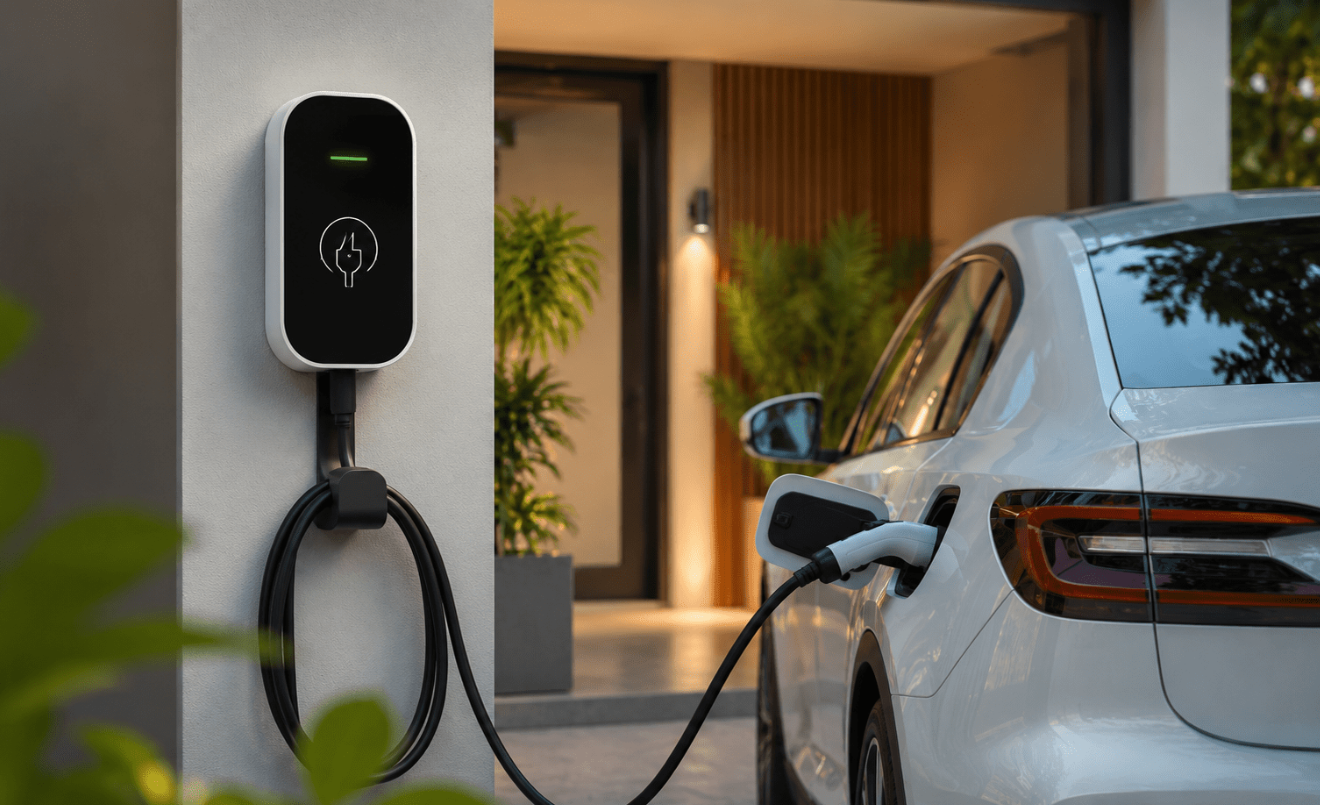
Installing a Level 2 EV charger at home typically costs $1,100 to $3,600 for the charger and installation combined, before major electrical upgrades or extensive construction. The final price depends on the charger you choose, the distance from your electrical panel, available electrical capacity, wiring requirements, and local permit fees.
According to EnergySage’s 2026 installation cost guide, installation alone commonly costs $800 to $3,000, excluding the charging equipment. A straightforward installation may cost less, while a home that needs a longer wiring run or electrical panel upgrade can cost substantially more.
Before purchasing a charger, it helps to understand what the installation quote includes, which upgrades your home may need, and whether any local incentives can reduce the upfront expense.
How Much Does a Home EV Charger Installation Cost?
The total cost of installing a home EV charger varies considerably from one property to another. The following figures provide a useful starting point for US homeowners budgeting for a Level 2 charging station.
| Cost component | Estimated cost |
|---|---|
| Level 2 EV charger | $300–$600 for many residential models |
| Standard professional installation | $800–$3,000 |
| Permits and inspection fees | $50–$800, depending on location |
| Additional wiring for a long-distance installation | Potentially $1,000–$1,500 extra |
| Electrical subpanel | $500–$1,500 |
| Main electrical panel upgrade | $1,500–$4,000 or more |
These figures are planning estimates, not a fixed-price quote. Some installation estimates include permit fees or certain materials, while others list them separately. Costs can overlap, so do not simply add every number to calculate your total.
EnergySage’s installation estimates are based on data from Qmerit, an EV charging installation network. Its guidance places typical installation costs at $800–$3,000 before equipment, with the home’s electrical setup being a major factor. See the full cost breakdown.
For comparison, Angi’s 2026 cost guide, updated in September 2026, reports an average installation cost of $967, with a typical range of $554–$1,380 based on 4,398 projects. The difference between these estimates reflects different datasets and project assumptions, so homeowners should treat national averages as a reference rather than a guaranteed price.
What Affects the Cost of Installing a Home EV Charger?
Several factors determine how much you will pay to install a Level 2 charger. Understanding them before requesting quotes can help you compare electricians’ proposals more effectively.
1. The Type of EV Charger You Choose
The charging station itself is one of the most straightforward costs to estimate.
Basic Level 2 chargers generally cost less than premium smart chargers with advanced scheduling, energy monitoring, solar integration, or dynamic load management.
The following table illustrates how different equipment budgets affect the overall installation expense.
| Charger budget | Installation budget | Estimated total |
|---|---|---|
| $300 | $800 | $1,100 |
| $450 | $1,200 | $1,650 |
| $600 | $2,000 | $2,600 |
| $600 | $3,000 | $3,600 |
These are illustrative calculations, not quoted packages or averages for specific installation types. The installation figures exclude any additional panel upgrade or major construction.
A more expensive charger does not necessarily require a more expensive installation. In many cases, the electrical work depends more on the property’s existing infrastructure than on the retail price of the charging station.
Before buying equipment, check the charger’s connector, power rating, installation requirements, outdoor suitability, warranty, and compatibility with your vehicle.
2. The Distance Between the Electrical Panel and the Charger
The distance between your electrical panel and the intended charger location is often one of the biggest installation cost factors.
If the panel is located in the garage or on the other side of the wall where the charger will be mounted, the electrician may need only a short cable run and relatively little additional labor.
If the panel is on the opposite side of the house, the installation may require considerably more wire, conduit, drilling, and labor. Running wiring through finished walls, ceilings, or an attic can add to the cost.
For installations requiring approximately 60–80 feet of additional wiring, EnergySage estimates that the extra expense can reach $1,000–$1,500, depending on the routing and materials required.
Detached garages and driveway charging locations can be more complicated because wiring may need to run outdoors or underground.
How to keep this cost under control: Choose a charger location that offers practical cable reach while minimizing the distance from the electrical panel. However, do not sacrifice safe access, weather protection, or convenient vehicle parking just to shorten the wiring route.
3. Whether Your Electrical Panel Has Enough Capacity
A Level 2 EV charger typically uses a 240-volt supply and can draw a substantial amount of current while charging. Your electrical panel must be able to support that additional load alongside existing appliances, heating and cooling equipment, and other electrical systems.
A qualified electrician can perform a load calculation to determine whether your existing service has sufficient capacity.
If additional capacity or distribution equipment is needed, the installation could involve one of several options.
Adding a new circuit: If the panel has sufficient capacity and an appropriate available position, the electrician may be able to add a dedicated circuit without replacing the panel. EnergySage lists a cost estimate of $60–$150 for adding a new circuit, although the complete installed cost depends on wiring, labor, and site conditions.
Installing a subpanel: A subpanel may help distribute electrical circuits when the existing panel is nearly full. EnergySage estimates $500–$1,500 for this option.
Upgrading the main electrical panel: A larger service or panel upgrade may be needed if the home’s available electrical capacity is insufficient. EnergySage estimates $1,500–$4,000 or more for a main panel upgrade.
These are different solutions, not upgrades that every homeowner must purchase. The correct approach depends on the electrical assessment and applicable local requirements.
Can You Avoid an Electrical Panel Upgrade?
Sometimes. A panel upgrade is not automatically necessary whenever a homeowner installs a Level 2 charger.
Depending on the existing system, an electrician may recommend a lower charging-current setting or an approved charger with dynamic load management. These approaches can help manage electrical demand by limiting EV charging when other household loads increase.
However, load management does not make every installation suitable. The electrician must determine whether the equipment and installation method are appropriate for the home’s electrical service and local code.
It is worth asking for an assessment of these alternatives before agreeing to a major panel replacement.
4. Plug-In Versus Hardwired Installation
Some Level 2 chargers connect through an appropriately installed 240-volt receptacle, while others connect directly to the electrical system through hardwiring.
The better option depends on the charger, the desired charging power, and your home’s existing electrical setup.
| Feature | Plug-in charger | Hardwired charger |
|---|---|---|
| Electrical connection | Uses a compatible 240V receptacle | Connects directly to the electrical wiring |
| Existing outlet | Useful if a suitable outlet and circuit already exist | Does not require a receptacle |
| Maximum output | Limited by the charger, receptacle, and circuit | Can support higher output on compatible models |
| Relocation | May be easier, subject to safe installation | Generally requires electrical work to relocate |
| Installation cost | Depends on the existing outlet and circuit | Depends on wiring, circuit, and installation complexity |
A plug-in charger may appear less expensive when a suitable outlet already exists. However, an existing receptacle must be checked for the required rating, wiring condition, grounding, and suitability for sustained charging.
Do not assume that a regular household outlet can support a Level 2 charger. Most Level 2 residential chargers require a suitable 208- or 240-volt circuit.
The US Department of Energy provides additional guidance in its home EV charging overview.
5. Permit and Inspection Fees
Electrical work may require a permit and inspection from the local building or electrical authority.
Requirements vary by state, county, and municipality. Some jurisdictions have streamlined procedures for residential EV chargers, while others require specific applications, inspections, or contractor documentation.
EnergySage estimates permit fees can range from $50 to $800, depending on the jurisdiction. Angi’s 2026 guide cites a more typical range of approximately $150–$200 when a permit is required.
The difference illustrates why location matters when estimating installation costs.
Before work begins, ask the electrician whether the quote includes:
- Permit application fees.
- Required inspection fees.
- Electrical drawings or other documentation, if applicable.
- Any return visit needed to complete an inspection.
A low quote may not include all these items, so make sure you compare the complete installed price rather than labor alone.
How Much Does It Cost to Install a Level 2 Charger in Different Homes?
The same charger can produce very different installation quotes depending on where it will be installed.
Consider these three illustrative scenarios.
Scenario 1: A Simple Garage Installation
Suppose the electrical panel is close to the garage wall, there is sufficient electrical capacity, and the electrician can install a new circuit with minimal additional wiring.
The installation is relatively straightforward because there is no need for a major panel upgrade or extensive construction.
In this situation, your costs may fall toward the lower end of the available installation estimates.
Scenario 2: A Garage Far From the Electrical Panel
Now suppose the electrical panel is inside the house, but the desired charging location is at the opposite end of the garage.
The electrician may need a longer wiring run, additional conduit, more labor, and possibly some drilling or wall repairs.
These requirements can push the installation cost higher even when the electrical panel itself has sufficient capacity.
Scenario 3: An Older Home With Limited Electrical Capacity
An older home may have limited spare electrical capacity after accounting for its existing appliances.
The electrician might need to install a subpanel, upgrade the main electrical service, or evaluate an appropriate load-management solution.
This type of installation can cost significantly more than a straightforward garage installation.
The key lesson is that the price of the charger itself tells you relatively little about the complete project cost. Your home’s electrical infrastructure is often the deciding factor.
Does Home EV Charger Installation Qualify for a Tax Credit?
US homeowners should be careful when budgeting around federal tax incentives.
The IRS states that the federal Alternative Fuel Vehicle Refueling Property Credit for individuals applied to eligible property placed in service from January 1, 2023, through June 30, 2026.
For qualifying residential installations, the former credit was generally 30% of eligible costs, up to $1,000 per charging port, subject to eligibility requirements.
Because June 30, 2026, has passed, homeowners planning a new installation after that date should not assume they can claim this federal residential credit. Consult the IRS guidance for the applicable eligibility rules and dates.
Are State or Utility Rebates Still Available?
Potentially. State governments, local programs, and electricity utilities may offer rebates or incentives for eligible EV charging equipment and installation.
However, program availability and eligibility can vary. Some programs may require particular charger models, specific installation methods, participation in a utility charging program, or installation by an approved contractor.
Check the current terms directly with your utility and relevant state or local authorities. Confirm that the program is active, that funding remains available, and that your installation qualifies before subtracting a rebate from your budget.
How Much Does It Cost to Run a Home EV Charger?
Installation is only part of the cost of charging an electric vehicle at home. You will also pay for the electricity used to replenish the battery.
The amount depends on your vehicle’s energy consumption, how far you drive, charging losses, and your electricity rate.
You can estimate the energy cost with this formula:
Charging cost = Electricity used (kWh) × Electricity rate ($/kWh)
For example, suppose your EV draws 30 kWh of electricity and your home electricity rate is $0.16 per kWh.
30 kWh × $0.16 = $4.80
The charging session would cost $4.80 in electricity under those assumptions. Actual costs may be higher because of charging losses or additional applicable charges.
Some utilities offer time-of-use rates that make electricity cheaper during certain hours. A smart charger with scheduling can help you take advantage of those rates when available.
For a more accurate estimate, use your actual electricity tariff and expected energy consumption rather than assuming that all US households pay the same rate.
Is a Level 2 Home EV Charger Worth the Cost?
For drivers who cover substantial daily mileage, have irregular schedules, or need faster charging between trips, a Level 2 charger can provide significant convenience.
It can make overnight charging more practical and reduce reliance on public charging stations.
However, not everyone needs to install one immediately.
The US Department of Energy notes that many EV drivers can meet their daily driving requirements using Level 1 charging if a suitable dedicated outlet is available near their parking location. Level 2 charging is particularly useful for longer commutes, larger batteries, or situations where the vehicle needs more energy than Level 1 can replenish during the available parking time.
Consider the following questions before committing to the investment:
- How many miles do you drive on a typical day?
- How long does your vehicle remain parked at home?
- Can Level 1 charging meet your daily energy needs?
- Does your home have sufficient electrical capacity for a Level 2 charger?
- How much would installation cost after accounting for any necessary upgrades?
- Are utility rebates or other local incentives available?
If Level 1 charging already meets your needs, you may be able to postpone the installation expense. If you regularly need faster charging, the convenience of Level 2 equipment may justify the upfront cost.
How to Reduce the Cost of Installing a Home EV Charger
A few practical steps can help you avoid unnecessary installation expenses.
Get Multiple Installation Quotes
Ask at least two or three qualified electricians to assess your property. Request itemized quotes that separate labor, charger equipment, wiring, breakers, permit fees, and any proposed upgrades.
This makes it easier to identify differences in scope and compare prices fairly.
Choose the Installation Location Carefully
A charger installed near the electrical panel may require less wiring and labor. Select a location with convenient cable reach while maintaining safe access and complying with the manufacturer’s installation requirements.
Avoid Paying for Unnecessary Charger Features
Premium connected features can be useful, but they are not essential for every household.
Choose a charger based on your vehicle, daily charging requirements, and available electrical capacity. Do not pay more for higher output if your vehicle or charging routine cannot benefit from it.
Ask About Load Management Before Upgrading the Panel
If your electrical service is limited, ask the electrician whether a compatible load-management system could be a safe and code-compliant alternative to a service upgrade.
The answer depends on the installation, so do not assume that load management will eliminate the need for electrical work.
Check Rebates Before Purchasing
Look for active programs offered by your utility, state, or local government before purchasing the charger. Some incentives have equipment, installation, or application requirements that must be satisfied to qualify.
Read the conditions carefully and confirm the program is funded and accepting applications.
Frequently Asked Questions
What is the average cost to install a Level 2 EV charger at home?
Installation estimates vary by source and project scope. EnergySage reports $800–$3,000 for installation before equipment, while Angi’s 2026 guide reports an average of $967 and a typical range of $554–$1,380. A charger may add approximately $300–$600 for many residential models. Electrical upgrades and major construction can increase the total.
How much does a Level 2 charger cost without installation?
Many residential Level 2 chargers cost around $300–$600, although prices vary with power output, connectivity, brand, cable configuration, and energy-management features. Premium products can cost more. Check the exact product price and included equipment before purchasing.
Do I need to upgrade my electrical panel to install an EV charger?
Not necessarily. An electrician must determine whether your existing service has enough capacity for EV charging. Depending on the home’s setup, a new circuit, an approved load-management system, a subpanel, or a main service upgrade may be appropriate.
Is it cheaper to install a plug-in or hardwired EV charger?
The difference depends on the existing electrical setup and the particular charger. A plug-in installation may be less expensive when a suitable 240-volt outlet and circuit already exist. If new electrical work is required, the costs can be similar. Hardwiring may also be necessary for higher output on certain models.
Do I need a permit to install a home EV charger?
Permit requirements vary by state and local jurisdiction. Check with your local building or electrical authority and confirm whether the electrician’s quote includes permits and inspections.
Can I install an EV charger myself?
Some products are marketed as DIY-friendly, but installing a new 240-volt circuit involves electrical hazards and must comply with applicable codes. If new wiring, a circuit, or hardwiring is required, use a qualified electrician familiar with EV charging installations and local requirements.
Does the federal EV charger tax credit still apply to new installations?
The IRS states that the individual residential Alternative Fuel Vehicle Refueling Property Credit covered eligible property placed in service through June 30, 2026. For new installations after that date, do not assume the former federal credit is available. State, local, and utility incentives may have separate rules.
Final Thoughts
The cost of installing a home EV charger depends less on the price of the charging station than on the electrical work required to support it.
For a typical Level 2 installation, a reasonable starting budget is approximately $1,100–$3,600 for equipment and installation before major upgrades or extensive construction. Projects involving long wiring runs, limited electrical capacity, or substantial building work can cost more.
Before purchasing a charger, ask a qualified electrician to assess your home’s electrical capacity and provide an itemized quote. Compare the complete installed costs of suitable charger options, verify local permit requirements, and check whether any active rebates apply.
A careful assessment can help you choose a charging setup that meets your daily driving needs without paying for unnecessary equipment or electrical work.