
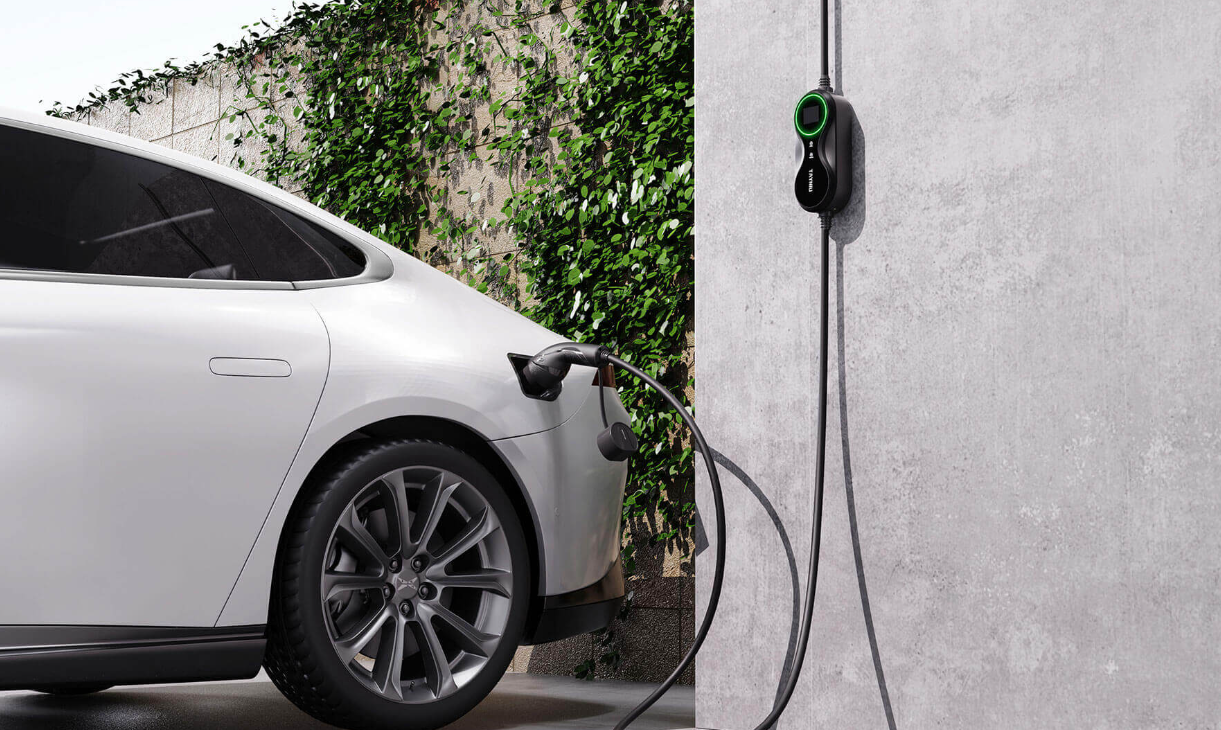
A portable Level 2 EV charger lets you charge an electric vehicle using a compatible 240-volt outlet without permanently mounting a charging unit to a wall. It can be useful for drivers who travel between properties, rent a home with suitable electrical outlets, or want a backup charging option for road trips.
However, portable does not mean that you can plug the charger into any outlet. The outlet, electrical circuit, charging unit, and vehicle must all be compatible. A higher-amperage charger may offer faster charging, but only when the electrical supply and the vehicle support its rated output.
This guide explains how portable Level 2 charging works, where it makes sense, which outlets and power ratings to consider, and the safety features worth checking before purchasing a portable Level 2 EV charger in the United States.
What Is a Portable Level 2 EV Charger?
A portable Level 2 EV charger is a transportable electric vehicle supply equipment (EVSE) unit designed to deliver AC electricity to an electric vehicle from a compatible power outlet.
Unlike a permanently installed wall-mounted charger, a portable unit typically has a power plug on one end, a vehicle connector on the other, and an inline control box that manages charging and provides safety functions.
In the United States, portable Level 2 chargers commonly use 240-volt AC power. Depending on the product, they may offer adjustable charging current, interchangeable manufacturer-approved input adapters, a carrying case, and different vehicle connector options.
The vehicle’s onboard charger converts incoming AC electricity into the DC energy stored in its battery. The portable EVSE controls the charging connection; it does not bypass the vehicle’s charging limits.
Portable Does Not Mean Battery-Powered
A portable Level 2 charger is not a battery pack that independently supplies electricity to your car. It still needs a suitable electrical source.
For example, a portable unit with a compatible NEMA 14-50 plug can charge an EV at a property with an appropriately installed NEMA 14-50 receptacle and adequate electrical capacity.
Without access to a suitable power source, the unit cannot provide Level 2 charging. A public parking space or campsite does not automatically have the electrical outlet needed to use one.
When Is Portable EV Charging Worth It?
A portable Level 2 charger can be valuable when flexibility matters more than a permanent installation.
1. Charging at More Than One Property
If you regularly stay at two homes or visit a family member with an appropriate 240-volt outlet, a portable unit may let you use compatible charging facilities at both locations.
Before relying on this arrangement, confirm that the outlet has the correct configuration and that its circuit is suitable for sustained EV charging. An outlet that fits the plug is not sufficient evidence of electrical compatibility.
2. Charging at a Rental Property
Renters may prefer equipment that can be removed and taken to another residence when they move.
However, owning portable charging equipment does not eliminate the need for a suitable outlet, landlord permission where applicable, or an electrician’s assessment if electrical work is needed.
If your rental property only has standard 120-volt outlets, you cannot use the Level 2 function without access to an appropriate higher-voltage supply.
3. Road Trips and Overnight Stays
A portable charger can be useful when your travel destination provides a suitable outlet and permits EV charging. It can supplement public charging by allowing you to recharge while parked overnight.
But do not assume that every hotel, vacation rental, campground, or RV site permits EV charging. Check the available electrical supply, site rules, and charging costs before relying on an outlet at your destination.
For longer trips, public charging stations are generally more predictable than searching for compatible outlets at each stop.
4. A Backup Charging Option
Some EV owners keep a portable charging unit in their vehicle for occasional situations where a compatible outlet is available.
This can provide flexibility, but the charger is not a replacement for a roadside assistance plan or access to public charging networks. It cannot help when no suitable electrical supply is available.
When a Portable Charger May Not Be the Best Choice
A portable unit may be less attractive if you charge at the same location every day and already have a convenient, suitable installation.
A permanently installed Level 2 charger may offer better cable management, a dedicated parking position, charging schedules, household energy management, or other features depending on the model.
If you live in an apartment without access to a suitable outlet, portable equipment alone does not solve the problem. Shared charging facilities, workplace charging, or public stations may be more practical.
Level 2 Charger Power: How Many Amps Do You Need?
Charging current is one of the most important specifications to compare when buying portable EV charging equipment.
At a nominal 240 volts, greater current generally allows the charger to deliver more power. The following calculations show the approximate output at common residential charging currents.
| Charging current | Approximate power at 240V | Typical circuit rating for a continuous load |
|---|---|---|
| 16 amps | 3.8 kW | 20 amps |
| 24 amps | 5.8 kW | 30 amps |
| 32 amps | 7.7 kW | 40 amps |
| 40 amps | 9.6 kW | 50 amps |
These are illustrative values. Circuit sizing must follow the applicable electrical code and equipment instructions. EV charging is generally treated as a continuous load, so a circuit rated at 50 amps does not normally mean that a 50-amp charging load can run continuously on that circuit.
Why a 40-Amp Charger Needs Special Attention
A portable charger advertised for 40-amp output commonly requires an appropriately installed 50-amp circuit. It must also have the correct input plug and be configured for that circuit.
A 32-amp charger typically requires a 40-amp circuit for continuous operation at its maximum output.
Never choose a charging current simply because an outlet appears large enough. Have the circuit and receptacle assessed, and follow the charger’s specified current limits.
Does Higher Amperage Always Mean Faster Charging?
No. The vehicle’s maximum AC charging capability can limit the power it accepts.
Suppose a portable charger can deliver 9.6 kW, but your vehicle supports a maximum AC charging rate of approximately 7.7 kW. The vehicle will not automatically charge at 9.6 kW just because the equipment can supply it.
Before paying extra for a higher-powered portable charger, check the vehicle’s owner’s manual or official technical specifications.
Also consider how much energy you need to replace overnight. If you regularly drive relatively few miles and park for many hours, a lower-powered charger may meet your needs.
Which Outlets Can a Portable Level 2 EV Charger Use?
Portable chargers are sold with different input plugs and adapter systems. The input connection must match the available receptacle and its electrical circuit.
In the United States, NEMA 14-50 is a common input configuration for portable Level 2 charging equipment. Other products may use NEMA 6-50, NEMA 14-30, NEMA 10-30, or lower-capacity connections, but not every charger supports each configuration.
| Outlet type | Typical application | What to verify |
|---|---|---|
| NEMA 14-50 | Some residential, garage, and RV electrical installations | Circuit capacity, receptacle condition, charger input rating, and maximum current |
| NEMA 6-50 | Some workshop and other 240V installations | Correct grounding arrangement, circuit capacity, and compatible charger plug |
| NEMA 14-30 | Some electric dryer installations | Whether the charger and its manufacturer-approved adapter support the outlet and its circuit |
| NEMA 6-20 | Certain lower-current 240V installations | Maximum supported current, correct receptacle, and charger compatibility |
These outlet types are not interchangeable simply because they provide higher-voltage electricity. Their configurations, grounding arrangements, and circuit ratings differ.
What About an Existing Dryer Outlet?
An existing dryer outlet might provide a compatible electrical supply for certain portable chargers, but it should not be assumed safe or suitable.
Some older installations may have different wiring arrangements, and an outlet could share a circuit with another appliance. A compatible manufacturer-approved adapter does not make an unsuitable circuit appropriate for continuous charging.
Ask a qualified electrician to assess the outlet, circuit capacity, grounding, wiring, and applicable code requirements before using it for an EV charger.
Can You Use a Portable Charger at an RV Park?
Potentially, but only if the site permits EV charging and provides an electrical connection explicitly compatible with your equipment.
Some RV pedestals provide 240-volt service, while others provide different outlet configurations or capacities. The receptacle, wiring, and protective equipment must be suitable for the intended load.
Do not assume that an RV outlet can safely supply the charger’s maximum rated current. Check the site rules and the electrical requirements before connecting.
Vehicle Compatibility: J1772, NACS, and Adapters
Before buying a portable Level 2 charger, check the connector that plugs into your vehicle.
Two important AC charging connector types in the U.S. market are SAE J1772 and SAE J3400, the latter associated with the North American Charging Standard (NACS).
A J1772 portable charger may be suitable for vehicles equipped with a compatible J1772 inlet. A vehicle with a NACS charging port may require a suitable adapter or a portable charging product equipped with the appropriate connector.
Do not rely solely on the vehicle manufacturer or model name. Connector compatibility can change with model year and configuration.
An adapter must be approved for the exact charging application. A physically compatible plug does not automatically guarantee that the vehicle, charger, and electrical system will work together safely.
Check the Vehicle’s Maximum AC Charging Power
A portable charger should be selected according to the vehicle’s maximum AC charging capability.
For example, an EV with a 7.7-kW AC charging limit will not benefit from a 9.6-kW portable charger’s full output when connected under otherwise comparable conditions. The vehicle’s onboard charger remains the limiting factor.
Check whether the product offers adjustable current settings, and ensure that the selected setting does not exceed the capacity of the installed circuit or the manufacturer’s specified limit.
Can a Portable Level 2 Charger Provide DC Fast Charging?
No. A conventional portable Level 2 EVSE supplies AC electricity. The vehicle’s onboard charger converts that electricity for storage in the battery.
Public DC fast charging uses different equipment that supplies DC power directly to the compatible vehicle charging system. Portable AC charging units should not be confused with DC fast-charging equipment.
Safety Features to Look for in a Portable Level 2 Charger
A portable charger may be moved between properties, plugged into different receptacles, and exposed to varying environmental conditions. Safety certification and appropriate protection features are therefore important purchasing considerations.
1. Recognized Electrical Safety Certification
Look for an actual certification or listing from a recognized testing organization, such as UL or Intertek (ETL), for the exact product model.
For the U.S. market, UL 2594 is a relevant standard for electric vehicle supply equipment. UL 2231 addresses personnel-protection systems for EV charging equipment. Verify the applicable standards and exact product listing rather than relying on a vague claim such as “tested for safety.”
A CE mark or an FCC-related statement alone is not a substitute for an appropriate U.S. electrical safety listing.
2. Ground-Fault and Leakage Protection
Appropriate ground-fault or leakage-current protection can help detect certain electrical faults and interrupt charging when necessary.
The specific protection design varies by charger. Check the manufacturer’s technical documentation rather than assuming that all portable units provide identical safeguards.
3. Overcurrent and Overtemperature Protection
Some models include protection against excessive current or high internal temperatures. Voltage monitoring and grounding checks may also be available.
These features provide additional safeguards, but they cannot compensate for damaged outlets, inadequate wiring, or an incorrectly sized circuit.
4. Outdoor and Weather Protection
If you intend to charge outdoors, confirm that the entire unit is rated for the expected environmental conditions and is installed and operated according to its instructions.
Check the specified environmental rating, operating temperature range, and requirements for the control box, connectors, and power connection. A weather-resistant charging unit does not make every household receptacle suitable for outdoor use.
5. Cable and Plug Quality
Inspect the cable, plug, connector, and housing for damage before use. Follow the manufacturer’s instructions for storage, cleaning, and maintenance.
Do not continue charging if you notice a damaged cable, melted or discolored plug, unusual heat at the connection, or a persistent fault indication. Stop using the equipment and seek qualified assistance.
Never Use Improvised Electrical Connections
Do not use ordinary extension cords, multiplug adapters, or improvised wiring to extend the reach of a portable EV charger.
Use only input adapters explicitly approved for the charger and the intended outlet. The U.S. Fire Administration recommends certified charging equipment and appropriate electrical installation.
Portable equipment still draws a substantial electrical load for extended periods. A charger with a safety shutoff is not a substitute for a correctly installed electrical supply.
Portable Level 2 Charger vs. Wall-Mounted Home Charger
The best choice depends on whether you value portability or a fixed daily charging setup.
| Consideration | Portable Level 2 charger | Wall-mounted Level 2 charger |
|---|---|---|
| Mobility | Can be disconnected and carried between compatible locations | Normally stays at one installation |
| Electrical supply | Requires a compatible outlet or a product-specific installation arrangement | May be hardwired or use a suitable receptacle, depending on the model |
| Installation | May avoid mounting work if a suitable outlet already exists | Mounting and potentially additional electrical work are required |
| Travel use | Useful when compatible outlets are available | Primarily intended for the installation location |
| Cable management | Cable and control box must be stored or positioned safely | May offer a fixed holster or integrated cable-management features |
| Smart features | Vary by model | May offer scheduling, energy monitoring, and household load-management features |
| Cost considerations | Equipment cost plus any required outlet installation | Equipment, mounting, wiring, permits, and possible upgrades |
A portable charger can be less expensive to put into service if you already have a suitable, properly installed outlet. It does not automatically eliminate electrical installation expenses.
For a permanent home setup, a wall-mounted charger may provide a cleaner daily arrangement. Some fixed models also support features designed for scheduled charging or managing electrical load across multiple devices.
Neither type is universally better. Choose according to the property, vehicle, charging frequency, and expected need for mobility.
What to Check Before Buying a Portable Level 2 EV Charger
Compare the following characteristics before choosing a specific model.
- Vehicle connector: Confirm J1772, NACS/J3400, or any required approved adapter.
- Input plug: Check the exact NEMA configuration and whether it matches a suitable outlet you can use.
- Charging current: Confirm maximum output and any adjustable current settings.
- Circuit requirements: Make sure the charger can operate within the safely installed circuit’s capacity.
- Safety certification: Verify the exact model’s listing and relevant electrical safety standards.
- Protection features: Review ground-fault, overcurrent, overtemperature, and grounding protections.
- Cable length: Check that the cable can comfortably reach the vehicle’s charging port without being stretched.
- Environmental rating: Confirm the product is suitable for the intended indoor or outdoor conditions.
- Portability and storage: Consider its actual weight, cable flexibility, storage case, and ease of handling.
- Warranty and support: Review the warranty, replacement-adapter availability, technical support, and maintenance instructions.
- Total cost: Include equipment, installation of a compatible outlet if needed, and any accessories required for your use case.
Smart features can be useful, but they should not take priority over basic electrical compatibility and safety certification.
How Much Does Portable EV Charging Cost?
The overall cost depends on the charging unit, required adapters, and whether you already have a compatible outlet.
If a suitable receptacle is already available, buying a portable charger may involve fewer installation expenses than adding a permanent charging station. If a new circuit or outlet is required, the electrical work can form a significant part of the total cost.
Ask for an itemized installation estimate if any electrical work is needed. It should identify equipment, labor, materials, permits, and any required panel or service upgrades.
Also consider the cost of future use. A portable charger that works with your current car may not suit a future vehicle or a different property. Adjustable current can provide flexibility, but connector and outlet compatibility still need to be verified.
The lowest advertised equipment price is not necessarily the best value if certification, support, cable reach, or compatible adapters are inadequate.
Frequently Asked Questions About Portable Level 2 EV Chargers
Can I use a portable Level 2 charger at home every day?
Yes, if the charger is designed for your intended use and connected to a suitable electrical supply. Regular daily charging requires a compatible outlet and circuit capable of safely supporting the sustained load. Portable equipment does not remove the need for proper installation.
Can a portable Level 2 EV charger plug into a regular household outlet?
The Level 2 function requires a compatible higher-voltage supply, typically 240 volts in U.S. residential applications. Some portable products support both Level 1 and Level 2 with appropriate input adapters, but a standard 120-volt outlet will not provide Level 2 charging.
Is a NEMA 14-50 outlet required for portable Level 2 charging?
No. NEMA 14-50 is common, but other compatible outlets are used by some products. The required input plug and circuit capacity depend on the charger’s design and output rating. Never assume an adapter makes an incompatible outlet suitable.
Can I leave a portable EV charger plugged in all the time?
Follow the product’s manual and the requirements of the installed receptacle. Portable equipment may be suitable for regular use, but plugs and receptacles should be inspected for wear or damage. Any signs of excessive heat, discoloration, or electrical fault require stopping use and checking the installation.
Is a portable Level 2 charger safe to use in the rain?
Some portable chargers are rated for outdoor use, but the rating applies to specified equipment and operating conditions. Confirm the product’s instructions for wet weather, and do not assume the receptacle or extension arrangement is safe simply because the charger itself is weather-resistant.
Can one portable Level 2 charger work with different EV models?
Often, but not automatically. The charger needs a compatible vehicle connector or an approved adapter, and its output must suit the vehicle’s charging limits. Verify compatibility for every vehicle you plan to charge.
Is a 40-amp portable charger better than a 32-amp model?
It can deliver more power when both the vehicle and electrical circuit support the higher output. A 40-amp charger typically requires a properly installed 50-amp circuit for continuous operation. If your vehicle has a lower AC charging limit or your available electrical supply supports less current, the extra capacity may not provide a practical benefit.
Final Verdict: Is a Portable Level 2 EV Charger Right for You?
A portable Level 2 EV charger is worth considering if you have access to compatible 240-volt outlets at multiple locations, need removable charging equipment, or want an additional charging option for travel.
Before buying, verify the input plug, circuit capacity, vehicle connector, maximum AC charging power, safety certification, and environmental rating. Treat portability as a convenience feature, not a reason to bypass electrical installation requirements.
If you charge every day at the same property, compare portable equipment with a properly installed wall-mounted charger. If you regularly travel between locations with suitable outlets, portability may offer real value.
The best portable charger is the one that matches your vehicle and electrical supply safely, provides enough charging power for your needs, and remains practical to carry and use.
Sources and Further Reading
- U.S. Department of Energy — Charging Electric Vehicles at Home
- U.S. Department of Energy — Electric Vehicles for Fleets
- U.S. EPA — Plug-In Electric Vehicle Charging Details
- U.S. Fire Administration — Electric Vehicle Fire Safety
- Tesla — Mobile Connector
- Tesla — Onboard Charger
- UL Solutions — Electric Vehicle Supply Equipment Standards
- TOPDON — PulseQ AC Portable EV Charger