
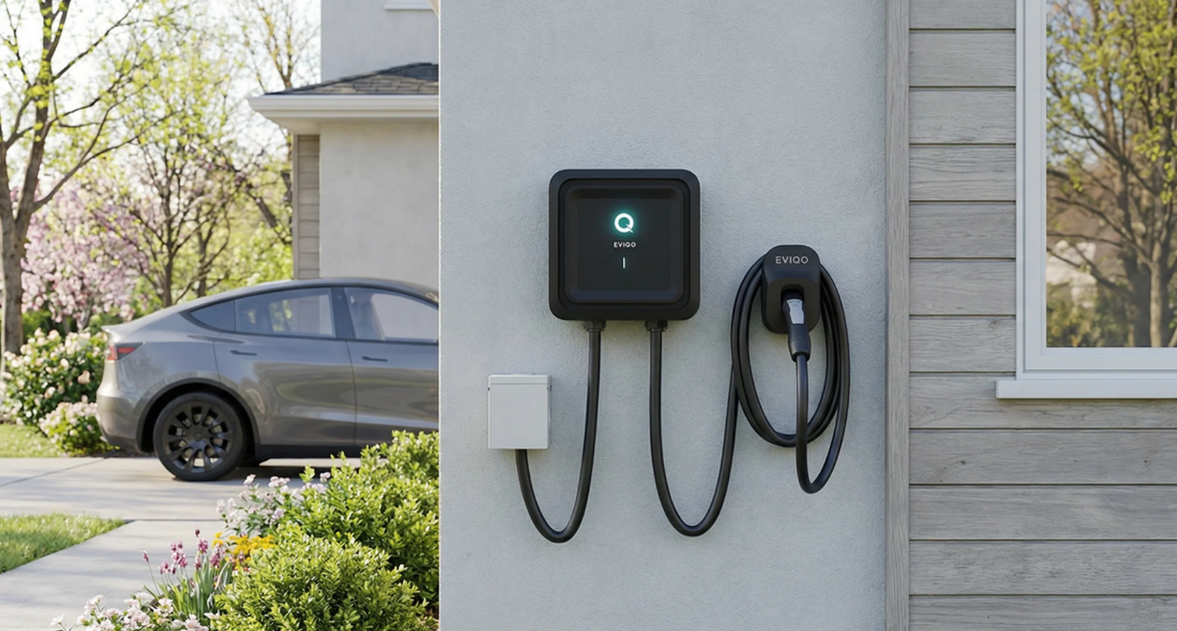
Choosing a home EV charger depends on more than charging speed. The best option for your home should match your vehicle’s charging port, electrical capacity, daily driving needs, installation location, and budget.
For many U.S. households, a Level 2 home EV charger provides convenient overnight charging using a 240-volt electrical supply. Some drivers need a simple, lower-cost charger, while others benefit from smart scheduling, household energy monitoring, or power management that helps avoid an electrical panel upgrade.
This guide compares five home chargers—ChargePoint Home Flex, Tesla Universal Wall Connector, Emporia Classic, Grizzl-E Classic, and Wallbox Pulsar Plus—using published specifications, manufacturer documentation, warranty information, and available independent customer-satisfaction data.
Review methodology: This is a specification-based comparison. The chargers were not physically installed or tested for this article, and no independent charging-speed, electrical-temperature, app-performance, or long-term reliability tests were conducted. Product recommendations are based on suitability for different needs, not claims of firsthand testing.
How to Choose a Home EV Charger
Before comparing individual models, establish five requirements: vehicle compatibility, charging power, electrical installation, features, and total cost.
1. Match the Charger to Your EV
The charger’s connector must match your vehicle’s charging inlet, either directly or through a manufacturer-approved adapter.
In the United States, SAE J1772 has been widely used for AC charging, while SAE J3400, associated with NACS, is becoming increasingly relevant across the market.
Some home chargers are sold with a J1772 connector, some with NACS, and some offer a choice. If you plan to change vehicles in the future, consider whether your next EV will use the same connector.
A charger with the wrong connector may still be usable with an appropriate adapter, but compatibility depends on the vehicle, adapter, and manufacturer requirements. Do not assume that an adapter intended for DC fast charging is suitable for home AC charging.
2. Choose an Appropriate Charging Power
Most residential Level 2 chargers use a 240-volt circuit. Charging power depends on the selected current and available voltage.
For example:
| Charging current | Approximate power at 240V | Typical circuit rating for continuous charging |
|---|---|---|
| 32 amps | 7.7 kW | 40 amps |
| 40 amps | 9.6 kW | 50 amps |
| 48 amps | 11.5 kW | 60 amps |
| 50 amps | 12.0 kW | 60 amps or more, as specified by the equipment and applicable code |
These are simplified examples. EV charging is generally considered a continuous electrical load, so circuit sizing must follow the applicable electrical code and the manufacturer’s installation instructions.
A 48-amp charger does not automatically charge every vehicle at 11.5 kW. The vehicle’s onboard AC charging limit may be lower, and the actual rate also depends on the electrical installation.
For many owners, a 32- or 40-amp charging setup may be adequate for overnight charging. Higher output is most useful when your driving needs, vehicle, and electrical supply can take advantage of it.
3. Check Your Home’s Electrical Capacity
A Level 2 EV charger requires an appropriate electrical circuit and, depending on the product, either a compatible receptacle or a hardwired connection.
If your panel has limited capacity, adding a charger at its maximum output may require electrical upgrades or a suitable load-management system.
A qualified electrician can assess the home’s available capacity, circuit requirements, wiring, grounding, permits, and potential service upgrades before you buy equipment.
A lower-powered charger or a model with compatible load management may be more economical than paying for unnecessary charging capacity or immediately upgrading the electrical service.
4. Decide Which Features You Will Actually Use
Smart features can help manage electricity use, but not every household needs them.
Consider whether you need:
- Scheduled charging to take advantage of time-of-use electricity rates.
- An app for remote control and charging-history monitoring.
- Energy monitoring or solar integration.
- Load management when electrical capacity is limited.
- Power sharing between multiple chargers.
- A longer cable or a specific indoor/outdoor enclosure rating.
If you mainly charge one vehicle overnight, a simple charger may be sufficient. If you have solar panels, two EVs, or limited electrical capacity, more advanced features may justify additional cost.
5. Compare the Total Installed Cost
The price of the charger is only part of the expense. Installation can include wiring, labor, a new receptacle, permits, and possible panel or service upgrades.
For budgeting, Wallbox’s U.S. shop describes typical home charger installation costs in the range of $500–$2,000. This is an indicative estimate from the manufacturer, not a national average or a guaranteed quote. Costs can exceed that range when major electrical upgrades are needed.
Request an itemized estimate from an electrician before deciding which charger offers the best overall value.
Best Home EV Chargers Compared
The following comparison focuses on five models with different strengths. Prices were checked against manufacturer pages on October 23, 2026, where a current listed price was available. Prices are for equipment, exclude installation and taxes, and may vary by configuration or availability.
| Charger | Best fit | Maximum published output | Connector | Equipment price observed | Warranty |
|---|---|---|---|---|---|
| ChargePoint Home Flex | Flexible charging-current settings and app features | Up to 50A / 12 kW | J1772 or NACS, depending on version | Check current listing | 3 years |
| Tesla Universal Wall Connector | Mixed J1772/NACS households | Up to 48A / 11.5 kW | NACS with integrated J1772 adapter | $660 listed; availability restricted when checked | 4 years residential |
| Emporia Classic | Value-oriented smart charging | Up to 48A hardwired; up to 40A plug-in | J1772 or NACS, depending on version | From $449 | 3 years |
| Grizzl-E Classic | Simple charging and robust enclosure | Up to 40A | J1772 | $299.99 listed | 3- or 5-year options shown; verify selected option |
| Wallbox Pulsar Plus | Compact design and advanced energy features | Up to 48A / 11.5 kW, depending on version | J1772 or NACS, depending on version | From $649.99 | 3 years |
Published output is a maximum rating, not a guarantee that your vehicle or home electrical supply will support it. Confirm the exact version before purchase. ChargePoint’s selected NEMA 14-50 product page showed an out-of-stock status when checked; Tesla’s Universal Wall Connector page also indicated availability restrictions at that time.
1. ChargePoint Home Flex: Best for Adjustable Charging Power
ChargePoint Home Flex supports adjustable charging output and offers connected features through the ChargePoint app. Manufacturer documentation lists versions with J1772 or NACS connectors, a 23-foot cable, and a three-year parts warranty.
Its adjustable output can be useful when the charging setup needs to be matched to the installed circuit. It can also help households avoid buying a charger that only offers one fixed charging current.
Why consider it: Adjustable charging current, app-based scheduling, charging information, and multiple installation configurations.
Potential limitation: The appropriate model and connection type must be confirmed before buying. Product availability and plug-in configurations can vary.
Suitable for: Drivers who want flexible charging settings and app-based control.
Official information: ChargePoint Home Flex.
2. Tesla Universal Wall Connector: Best for Mixed Connector Households
Tesla Universal Wall Connector combines a NACS charging connector with an integrated J1772 adapter. This design can be useful in a household where a Tesla and a compatible J1772 vehicle need to charge at the same location.
Tesla lists up to 48 amps and 11.5 kW of output, a 24-foot cable, Wi-Fi connectivity, app controls, and a four-year residential warranty.
The product also supports power-management features designed to help match charging output to the home’s electrical capacity. Some dynamic power-management features require additional compatible hardware and professional installation.
Why consider it: Integrated J1772 compatibility, a longer cable, app features, and a four-year residential warranty.
Potential limitation: It is hardwired and requires qualified installation. The manufacturer’s store page listed the product at $660 when checked but showed restricted availability.
Suitable for: Households with compatible Tesla and J1772 vehicles that want a combined connector solution.
Official information: Tesla Universal Wall Connector.
3. Emporia Classic: Best Value-Oriented Smart Charger
Emporia Classic combines Level 2 charging with app-based scheduling and energy monitoring. The manufacturer’s store listed the charger from $449, with connector options for J1772 and NACS.
Published specifications support up to 48 amps when hardwired and up to 40 amps with the appropriate plug-in configuration. Emporia lists a 25-foot cable and a three-year warranty.
For buyers who want smart charging without purchasing a more advanced whole-home energy-management system, the Classic is worth comparing.
Why consider it: Smart scheduling, charging data, a long cable, and flexible hardwired or plug-in configurations.
Potential limitation: Advanced features such as solar charging and expanded power management may require additional equipment or an upgraded model.
Suitable for: Drivers who want connected charging and an attractive equipment price without necessarily needing advanced household energy management.
Official information: Emporia Classic EV Charger.
4. Grizzl-E Classic: Best for Simple, Non-Connected Charging
Grizzl-E Classic offers a simpler alternative for buyers who do not need Wi-Fi, an app, or advanced energy-management features.
United Chargers lists the Classic at $299.99 on its official U.S. product page, with up to 40 amps, a 25-foot cable, an aluminum enclosure, and J1772 compatibility. The product documentation lists UL certification and ENERGY STAR certification.
The manufacturer shows three- and five-year warranty options. Check the exact option and any additional cost before purchasing.
Why consider it: A relatively low listed equipment price, a rugged enclosure, outdoor-use rating, and adjustable charging current.
Potential limitation: The Classic does not provide internet-connected smart features, and the listed model uses J1772 rather than a native NACS connector.
Suitable for: Drivers who prioritize straightforward charging over app controls and advanced connectivity.
Official information: Grizzl-E Classic.
5. Wallbox Pulsar Plus: Best for Compact Design and Advanced Energy Features
Wallbox Pulsar Plus is a compact Level 2 charger offered in 40-amp and 48-amp configurations. Its U.S. product information lists both J1772 and NACS versions, a 25-foot cable, Wi-Fi and Bluetooth connectivity, and a three-year warranty.
The manufacturer’s listed starting price was $649.99 when checked. The exact cost varies by version and availability.
The charger supports scheduled charging. Solar charging and dynamic load-management functions require a compatible Wallbox Power Meter, which the manufacturer listed separately at $299.
Why consider it: Compact dimensions, connected controls, connector choices, and options for solar charging and load management.
Potential limitation: The higher initial cost and additional energy-management hardware can increase the overall price.
Suitable for: Buyers who value a compact smart charger and may want solar or electrical load management.
Official information: Wallbox Pulsar Plus.
Which Home EV Charger Is Best for Your Situation?
Instead of choosing based only on brand or maximum amps, match the charger to the problem you need to solve.
| Your priority | Models worth comparing | Why |
|---|---|---|
| A simple, lower-cost setup | Grizzl-E Classic | Lower published equipment price and straightforward functionality |
| Smart charging on a moderate budget | Emporia Classic | App controls, scheduling, and energy data |
| Flexible current settings | ChargePoint Home Flex | Multiple current settings and connected features |
| J1772 and NACS compatibility in one unit | Tesla Universal Wall Connector | Integrated J1772 adapter and NACS connector |
| Compact design and optional energy management | Wallbox Pulsar Plus | Compact charger with additional load-management and solar options |
| Limited electrical capacity | Emporia Pro or a suitable load-management setup | Dynamic power management may help avoid an electrical service upgrade, depending on the home |
These are use-case recommendations based on published features, not findings from comparative hands-on tests. The correct choice can change if your vehicle has a lower onboard AC charging limit, your utility requires a specific approved charger, or your installation budget is constrained.
What Does Independent Customer-Satisfaction Data Say?
J.D. Power’s 2026 U.S. Electric Vehicle Experience Home Charging Study provides additional context about charger ownership. The study surveyed 5,399 owners of model-year 2020–2026 battery-electric and plug-in hybrid vehicles between November 2025 and February 2026.
Among permanently mounted Level 2 home charging stations, the reported satisfaction rankings were:
| Brand | Satisfaction score |
|---|---|
| Tesla | 771 |
| Emporia | 761 |
| ClipperCreek | 760 |
| Grizzl-E | 759 |
| Wallbox | 735 |
| Segment average | 733 |
| ChargePoint | 717 |
Scores are measured on a 1,000-point scale. J.D. Power reported that permanently mounted Level 2 chargers had the highest satisfaction of the three charging categories studied, but also the highest problem count per 100 chargers, partly because these products include more connected features.
These rankings reflect owner satisfaction across factors such as charging speed, cable handling, price, ease of use, reliability, and charger size. They are not laboratory measurements of charging efficiency, and small score differences should not automatically be interpreted as statistically meaningful.
The data provides useful independent context, but it does not establish which charger will work best with a particular vehicle or electrical installation.
Source: J.D. Power — 2026 U.S. EVX Home Charging Study.
Installation: Plug-In vs. Hardwired Home Chargers
The installation method affects both cost and charging power.
Plug-In Chargers
A plug-in charger connects to a compatible receptacle, commonly NEMA 14-50 on some residential Level 2 models.
Potential advantages include easier equipment removal and the possibility of using an existing suitable outlet. However, a receptacle must be correctly wired and rated for continuous EV charging. An existing dryer or RV outlet should not be assumed suitable without assessment.
Many plug-in chargers operate at lower maximum current than their hardwired equivalents. For example, Emporia Classic supports up to 40 amps in the specified plug-in configuration, compared with up to 48 amps when hardwired.
Hardwired Chargers
A hardwired charger is connected directly to the home’s electrical system. This may be appropriate for permanent installations or equipment requiring a higher charging current.
Hardwired installation generally requires a qualified electrician, appropriate circuit protection, and compliance with local code and permitting requirements.
Do not select a 48- or 50-amp charging setting without confirming that the home’s circuit and service can safely support it.
Outdoor Installation
Outdoor installation can be appropriate when the charger and electrical installation are rated for the intended conditions. Check the manufacturer’s enclosure rating, temperature limits, mounting requirements, and cable guidance.
Use properly listed equipment and have the installation assessed by a qualified professional. Outdoor-rated charging equipment does not make an unsuitable receptacle or damaged cable safe.
Home Charger Features Worth Paying For
Smart features are most valuable when they address a real need.
Scheduled charging: Useful for charging during lower-cost utility periods when your electricity rate varies by time of day.
Energy monitoring: Helps you see how much electricity the vehicle uses and estimate charging expenses.
Dynamic load management: Adjusts charging power based on available electrical capacity. This may help some homes avoid a service upgrade, although required meters and installation costs must be considered.
Power sharing: Can distribute available power between multiple chargers when a household has more than one EV.
Solar integration: Can help coordinate charging with surplus solar generation, often requiring compatible metering equipment.
Cable management: A longer cable and a well-designed holder can make daily use more convenient, particularly when vehicles have different charging-port locations.
Consider the total cost of any required accessories, monitoring hardware, subscriptions, or utility-program participation before selecting a feature-rich unit.
Warranty, Returns, and Customer Support
A warranty is an important buying criterion, but it should not be treated as a guarantee of reliability.
The manufacturer-published warranty periods for the models compared above are generally three years, with Tesla’s Universal Wall Connector listing four years for normal residential use. Grizzl-E presents different warranty options on its product page, so the selected term should be confirmed.
Before purchasing, check:
- What is covered and excluded.
- Whether installation must follow specific requirements.
- Whether labor, shipping, or removal costs are included.
- How replacement or repair claims are handled.
- Whether the company provides installation guides and troubleshooting support.
- Whether replacement cables or connectors are available.
A lower-cost charger with a shorter or more restrictive warranty may not be better value than a more expensive unit. Conversely, a longer warranty does not prove that a product is technically superior.
Frequently Asked Questions About Home EV Chargers
What is the best home EV charger?
There is no single best charger for every household. Emporia Classic is worth comparing for smart features at a moderate equipment price, Grizzl-E Classic for simpler charging, Tesla Universal Wall Connector for its combined NACS/J1772 connector design, ChargePoint Home Flex for adjustable current, and Wallbox Pulsar Plus for compact design and energy-management options.
How many amps should my home EV charger have?
Many households compare 32-, 40-, and 48-amp Level 2 chargers. The correct option depends on your vehicle’s AC charging limit, the home’s electrical capacity, and how much range you need to recover overnight. Have a qualified electrician determine the appropriate circuit and output setting.
Should I buy a plug-in or hardwired charger?
A plug-in unit may be suitable when a compatible receptacle is available and its circuit is appropriate for continuous charging. Hardwired chargers can support higher current on some models. The choice depends on equipment specifications, local requirements, installation costs, and available electrical capacity.
Do all home EV chargers work with Tesla?
No. The connector must match the vehicle’s charging inlet, either directly or through an appropriate manufacturer-approved adapter. Some chargers come with NACS connectors; others use J1772. Confirm your vehicle’s compatibility before buying.
Is a smart home EV charger worth the extra cost?
It may be worthwhile if you plan to schedule charging around time-of-use rates, monitor electricity use, manage multiple chargers, or integrate solar power. If you need only basic overnight charging, a simpler product may be sufficient.
How much does it cost to install a home EV charger?
The installation price depends on the property’s electrical capacity, the distance from the panel, wiring, permits, and whether a service upgrade is needed. Manufacturer guidance suggests that installation can cost hundreds to a few thousand dollars. Obtain an itemized local quote before budgeting.
Which home EV charger has the best warranty?
Tesla Universal Wall Connector lists a four-year warranty for normal residential use among the models compared here. ChargePoint, Emporia, and Wallbox generally list three years, while Grizzl-E offers warranty options that should be checked for the exact product selection. Warranty length alone does not establish overall reliability.
Final Verdict: Choose the Home EV Charger That Fits Your Home
A good home EV charger should match your vehicle connector, electrical system, daily charging requirements, and budget. Maximum charging power is only one consideration.
For a lower equipment price and simple functionality, compare Grizzl-E Classic. For connected charging and energy monitoring, consider Emporia Classic. For a mixed J1772/NACS household, evaluate Tesla Universal Wall Connector. ChargePoint Home Flex offers adjustable current, while Wallbox Pulsar Plus is worth investigating if compact design and additional energy-management features matter to you.
Before purchasing, verify the exact model, connector, warranty, safety certification, and installation requirements. Include electrical work in the total budget, and confirm that the charger’s maximum power is useful for your vehicle.
The best home EV charger is not necessarily the most powerful or the most expensive. It is the one that meets your needs safely, conveniently, and without paying for features or installation capacity you will not use.