
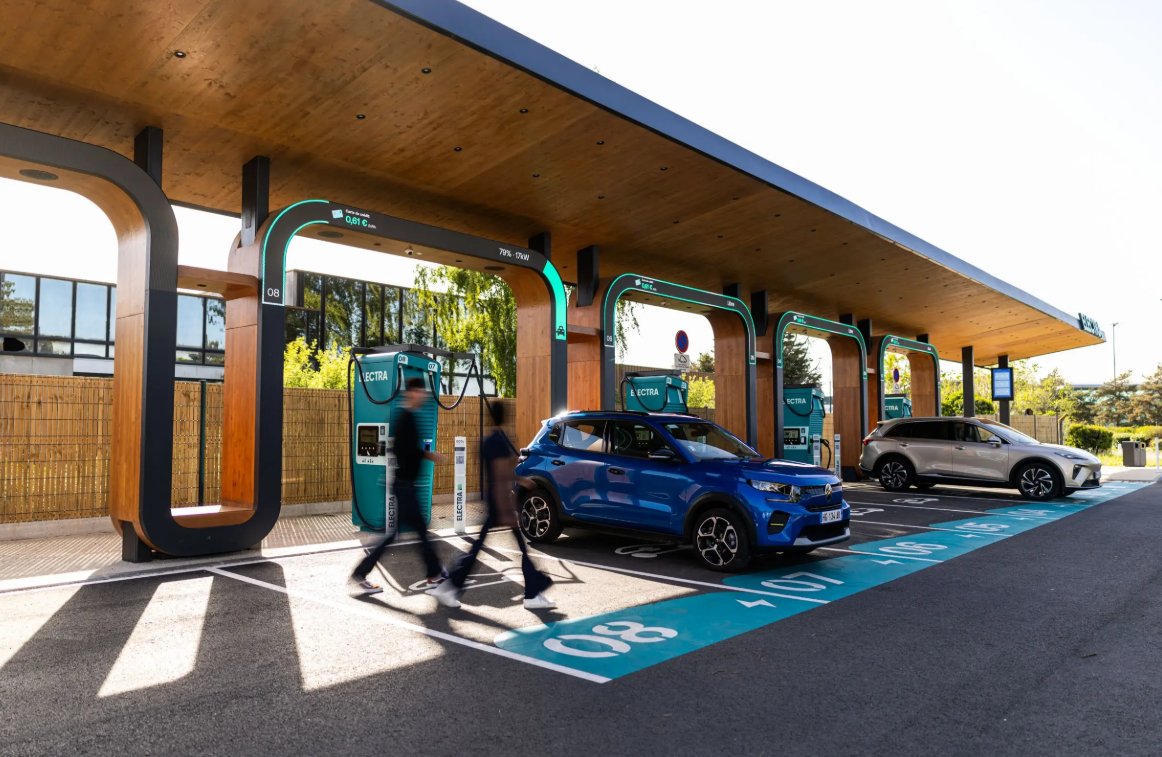
The best EV charging network depends on your vehicle, driving habits, and the locations where you need to charge. Tesla Supercharger is a strong option for compatible vehicles and highway travel, IONNA leads J.D. Power’s 2026 public DC fast-charging satisfaction rankings among eligible networks, Electrify America offers extensive public fast-charging coverage, EVgo provides fast charging with several payment and membership options, and ChargePoint is useful for finding public charging at destinations and in local areas.
These networks are not interchangeable. Some focus on high-power DC fast charging for road trips, while others connect drivers to thousands of public charging points, including slower Level 2 stations. Pricing, connectors, payment methods, and access for non-Tesla vehicles also vary.
This guide compares the major public EV charging networks in the United States to help you find the right option for everyday charging, highway travel, and occasional top-ups.
Best EV Charging Networks at a Glance
| Network | Best for | Coverage and charging focus | Pricing and payment | Main consideration |
|---|---|---|---|---|
| Tesla Supercharger | Highway travel for compatible vehicles | Extensive dedicated DC fast-charging network | Site-specific pricing through the Tesla app; membership can reduce costs for eligible non-Tesla users | Not every site is open to every EV |
| IONNA | Customer experience at available high-power sites | Growing DC fast-charging network with NACS and CCS connectors | Card, mobile wallet, Plug & Charge, and supported partner apps; no mandatory proprietary app | Smaller footprint than established networks |
| Electrify America | Public DC fast charging across major U.S. routes | Broad fast-charging network with CCS and a phased NACS rollout | Site- and plan-dependent pricing; card reader, app, and supported digital payments | Confirm connector availability and current pricing at each location |
| EVgo | Urban and regional fast charging | Public DC fast chargers across the United States | App, RFID, credit card, and subscription plans | Coverage and pricing depend on region |
| ChargePoint | Workplace, destination, and other public charging | Broad network with many Level 2 stations and some DC fast charging | Prices are generally set by station owners or roaming partners; app and other supported access methods | Not all listed stations share the same operator or pricing |
Best starting point: Check Tesla Supercharger and IONNA for suitable DC fast-charging sites on your regular routes, compare Electrify America and EVgo as alternatives, and use ChargePoint to find additional public charging near your destination.
No network should be selected solely by its national size. A station that is incompatible, unavailable, inconveniently located, or significantly more expensive for your trip may not be the best choice.
1. Tesla Supercharger: Best for Compatible EV Road Trips
Tesla Supercharger is an important option for drivers who prioritize highway fast charging. Its network has a substantial U.S. presence, and Tesla provides station availability, charging speeds, and location-specific prices through its app.
In the U.S. Department of Energy’s Alternative Fuels Data Center network registry, Tesla Supercharger was listed with 43,469 charging ports in its October 13, 2026 import. That figure represents registered charging ports rather than the number of stations, and it should not be treated as a live operational count.
Coverage and location access
Tesla Superchargers are located along many major travel corridors and in numerous metropolitan areas. Their usefulness depends on the route and whether the particular station supports your vehicle.
Tesla currently distinguishes between three types of Supercharger sites:
- Tesla-only locations.
- Locations with a built-in Magic Dock adapter that supports compatible non-Tesla vehicles.
- NACS locations that support eligible non-Tesla EVs, subject to manufacturer access and approved adapter requirements.
A non-Tesla vehicle does not automatically have access to every Supercharger. Check Tesla’s official non-Tesla Supercharging guide and enter your vehicle details before planning a charging stop.
Pricing, app, and payment
Tesla displays prices by site in its app, and some locations offer different peak and off-peak rates. Compatible non-Tesla drivers can use the Tesla app to find an eligible location, add vehicle details, register a payment method, and start a session.
Tesla also provides direct credit-card or mobile payment at a limited number of sites. Membership is optional for non-Tesla drivers, but an eligible Supercharging membership may reduce charging costs.
Connectors and reliability
Superchargers use NACS-compatible connections, with supported access for some CCS1 vehicles through manufacturer-approved NACS DC adapters or a built-in Magic Dock. Tesla expressly prohibits unsupported third-party adapters.
Tesla Supercharger ranked highest among DC fast-charging networks in J.D. Power’s 2025 U.S. EVX Public Charging Study. However, the latest 2026 study placed IONNA, Mercedes-Benz Charging Network, and Rivian Adventure Network first through third among its eligible DC fast-charging networks. These rankings measure customer satisfaction, not a guaranteed uptime rate for every individual station.
Best for: Drivers whose vehicles are eligible for Supercharging and who regularly travel routes with convenient Tesla locations.
Main limitation: Access is station- and vehicle-specific, and the lowest price may require a membership for eligible non-Tesla vehicles.
Official resources: Tesla Supercharging and Supercharging other EVs.
2. IONNA: Best for Customer Satisfaction at Available Sites
IONNA is a newer U.S. fast-charging network founded by eight automakers: BMW, General Motors, Honda, Hyundai, Kia, Mercedes-Benz, Stellantis, and Toyota.
Its Rechargeries are designed as public charging destinations, combining high-power charging with amenities such as restrooms and food or drink options at many locations.
Coverage and location access
IONNA is expanding across the United States. On October 16, 2026, the company announced that it had reached 200 live Rechargeries, with its footprint extending from North Carolina to Washington.
This is meaningful growth, but drivers should distinguish network quality from network density. Two hundred charging sites cannot provide the same route flexibility as a much larger, mature network in every state or region.
Check the IONNA station locator to see whether its current locations fit your route.
Pricing, apps, and payment
IONNA takes a different approach from networks built around a proprietary driver app. Its Rechargeries support payment directly at the charger by credit card, Apple Pay, or Google Pay, as well as Plug & Charge and selected automaker and charging-partner apps.
The company advertises no mandatory app, no idle fees, and no session fees. That does not mean the electricity itself is free; check the displayed energy price before beginning a charging session.
IONNA also supports several partner apps, including ChargePoint, ChargeHub, EV Connect, and selected vehicle-manufacturer apps. Availability of individual integrations may vary by vehicle and station.
Connectors and reliability
IONNA provides NACS and CCS connectors across its network. Most dispensers support both, but the exact connector selection should be checked for the intended location. The company also supports certain dealer-purchased adapters.
In the 2026 J.D. Power U.S. EVX Public Charging Study, IONNA scored 807 out of 1,000, ranking first among eligible DC fast-charging networks. Mercedes-Benz Charging Network scored 797 and Rivian Adventure Network scored 755.
This is strong evidence of customer satisfaction, but it should be interpreted alongside IONNA’s smaller footprint. A high satisfaction score does not guarantee that a convenient charger exists on your route or that every session will be trouble-free.
Best for: Drivers who have an IONNA location nearby or along a regular road-trip route and value a simple payment experience and destination-style amenities.
Main limitation: Its coverage is still expanding, so it is better used as a route-specific option than assumed to be universally available.
Official resources: IONNA Rechargeries and IONNA payment FAQs.
3. Electrify America: Best for Broad Public Fast-Charging Access
Electrify America is one of the principal non-Tesla public fast-charging networks in the United States. Its sites serve drivers who need high-power charging along interstate corridors, near retail destinations, and in metropolitan areas.
The company reports more than 5,600 hyper-fast chargers across more than 1,080 stations in North America. In the DOE Alternative Fuels Data Center registry, Electrify America had 6,215 registered charging ports in the October 23, 2026 import. These figures use different reporting definitions and should not be compared as if they were the same metric.
Coverage and charging speed
Electrify America provides extensive public DC fast-charging coverage, although route planning remains essential in areas with fewer sites.
Many chargers support outputs up to 350 kW. This is a charger rating, not a guaranteed rate for your car. A vehicle’s battery, temperature, state of charge, and maximum charging capability determine the power it can actually accept.
Pricing, app, and payment
Electrify America determines DC fast-charging prices based on station location, the plan selected, and the energy delivered. Its app displays real-time pricing and station information.
The company offers Pass+ membership, which it advertises as saving about 25% on charging. Whether a membership makes sense depends on how often you use the network and the actual prices at the stations you visit.
Payment options include:
- Credit or debit cards at supported station card readers.
- The Electrify America app.
- Supported automaker apps.
- Apple Pay and Google Wallet.
Some stations use time-of-use pricing, while idle fees may apply when a vehicle remains connected after charging is complete.
Connectors and network changes
CCS1 remains widely available across Electrify America, and some legacy locations also support CHAdeMO. Electrify America is rolling out NACS/J3400 connectors through a phased pilot rather than converting every charger at once.
Before choosing a station, inspect its connector details in the app. If you drive a vehicle with a NACS port, do not assume every Electrify America site has a matching connector.
Best for: Non-Tesla drivers looking for an established public fast-charging network for regular travel and road trips.
Main limitation: Pricing varies by location and membership, while NACS availability is still site-specific.
Official resources: Electrify America station locator and pricing and payment options.
4. EVgo: Best for Flexible Fast-Charging Access and Membership Options
EVgo operates a substantial U.S. public DC fast-charging network. It is worth comparing for regular regional driving, urban charging, and routes where its stations are conveniently located.
EVgo advertises more than 1,200 public fast-charging stations nationwide. The DOE registry listed 5,358 charging ports in its October 23, 2026 import.
Coverage and location availability
EVgo stations serve a range of metropolitan and regional markets. Its actual usefulness depends on whether its fast chargers are positioned along the roads you drive and whether enough connectors are available at your preferred stops.
Use the EVgo station map to check current location coverage and station details.
Pricing, app, and payment
EVgo supports its mobile app, RFID access, and direct credit-card payment at compatible stations. It also offers Autocharge+, which can start eligible charging sessions automatically when a supported vehicle is plugged in. Eligibility depends on the vehicle and its charging communications.
EVgo offers pay-as-you-go charging and subscription plans. Its published plan guide, last updated September 17, 2025, listed:
| Plan | Published monthly price | Intended use |
|---|---|---|
| Pay As You Go | No monthly subscription | Occasional charging |
| EVgo Plus | $6.99 | Approximately 3–5 sessions a month |
| EVgo PlusMax | $12.99 | Approximately 6 or more sessions a month |
The published guide describes potential savings of up to 15% for Plus and up to 30% for PlusMax compared with standard rates. These are plan-specific maximum savings, not a guarantee that every customer will save those amounts. Confirm the current price, regional rate, and terms in EVgo’s app before subscribing.
Connectors and charging experience
EVgo supports CCS charging and has CHAdeMO equipment at some stations. It is also expanding NACS support, but connector availability varies by site.
EVgo’s Autocharge+ works only with eligible vehicles and compatible charging communications. For drivers whose vehicles qualify, it can reduce the number of steps required to begin charging.
Best for: Drivers who regularly use EVgo locations and can benefit from its payment features or subscription pricing.
Main limitation: Membership savings depend on local pricing and charging frequency, so a subscription is not automatically worthwhile.
Official resources: EVgo network, EVgo plans, and Autocharge+.
5. ChargePoint: Best for Finding Public and Destination Charging
ChargePoint serves a different role from networks focused primarily on dedicated DC fast charging. Its footprint includes a large number of public Level 2 ports at workplaces, hotels, parking facilities, retail locations, and other destinations, as well as some DC fast chargers.
The DOE Alternative Fuels Data Center listed 92,549 ChargePoint charging ports in its October 23, 2026 import. That large figure includes a mix of charging levels and must not be read as 92,549 fast chargers or individual stations.
Coverage and location availability
ChargePoint’s app helps drivers locate publicly accessible stations in its network and participating roaming networks. The company lists partners including EVgo, FLO, and other charging providers.
This makes ChargePoint useful when you want to find somewhere to charge while working, shopping, staying overnight, or visiting a destination.
However, a station appearing in ChargePoint’s app does not necessarily mean ChargePoint owns or operates the physical charger. The owner or roaming partner may determine the pricing, equipment, and operating conditions.
Pricing and payment
ChargePoint generally lets each station owner or roaming partner determine the charging price. Depending on the specific station, charging may be priced per kWh, by time, through a flat fee, or under other station-specific terms.
Check the price in the app before starting. The price shown through a third-party charging app or RFID service can differ from the station’s direct price.
ChargePoint’s app can be used to find and access supported public stations. Some stations also support RFID cards or third-party charging services, depending on their configuration.
Connectors and reliability
ChargePoint offers access to a mix of charging types, so connector compatibility depends on the particular location. Many destination chargers use J1772 for AC charging, while some faster charging locations support CCS or other connectors.
For customer satisfaction, J.D. Power’s 2025 public charging study ranked ChargePoint second among Level 2 public charging providers, behind Tesla Destination. This is a useful historical comparison for destination charging, but it is not a 2026 ranking or a technical uptime measurement.
Best for: Drivers seeking Level 2 charging near work, hotels, shopping, and other daily destinations, or looking for more station options through one app.
Main limitation: Pricing, connector selection, and service quality differ by individual station because the network includes independently operated equipment.
Official resources: ChargePoint station access and how charging prices are set.
How Do EV Charging Networks Compare on Pricing?
There is no single price that applies across the United States. Public charging rates depend on the station, region, membership, electricity pricing structure, and sometimes the time of day.
| Network | How pricing works | What to check before charging |
|---|---|---|
| Tesla Supercharger | Prices displayed by site in the Tesla app; some sites have peak and off-peak rates | Vehicle eligibility, membership price, and congestion fees |
| IONNA | Charging price is shown at the site or through supported payment methods; company advertises no session or idle fees | Energy rate, connector availability, and supported payment options |
| Electrify America | Location- and plan-dependent pricing, with Pass+ savings and select time-of-use pricing | Current station rate, subscription benefits, and idle fees |
| EVgo | Rates vary by region and plan; subscriptions may reduce eligible charging costs | Local per-kWh or per-minute price, subscription cost, and session fees |
| ChargePoint | Station owner or roaming partner sets the price | Actual price shown in the app and possible time-based or idle fees |
How to compare the actual cost of a charging session
Use a consistent amount of energy when comparing networks.
For example, if a network charges $0.50 per kWh, receiving 40 kWh of electricity would cost $20 before any additional fees.
That is an illustrative calculation, not a quoted price from any one network. The same 40 kWh session could cost more or less depending on the site and plan.
For a meaningful comparison, include any subscription charge, applicable session fees, parking expenses, and the vehicle’s energy consumption. The cheapest advertised rate may not be the cheapest choice if you must pay a monthly membership for only one or two sessions.
Which EV Charging Network Is the Most Reliable?
Reliability is more complicated than counting stations or comparing maximum charging power. A useful assessment considers whether a driver can locate a station, access an available connector, start a session, complete the charge, and pay without unexpected problems.
The J.D. Power 2026 U.S. EVX Public Charging Study reported the following DC fast-charging satisfaction rankings among eligible networks:
| Rank | Network | Customer satisfaction score |
|---|---|---|
| 1 | IONNA | 807 |
| 2 | Mercedes-Benz Charging Network | 797 |
| 3 | Rivian Adventure Network | 755 |
Scores are measured on a 1,000-point scale. J.D. Power reported that the industry’s public DC fast-charging satisfaction reached 666 in the 2026 study and that the non-charging visit rate fell to 12% in the most recent quarter covered by the study.
These figures provide evidence about customer satisfaction and unsuccessful charging visits, not a guarantee that a particular charger will work when you arrive. The study’s eligibility and rankings also should not be treated as a complete ranking of every network in the country.
Before a long trip, check live station status, the number of stalls, connector compatibility, recent operational information if available, and the distance to an alternative station. A nearby station with multiple working stalls can be more useful than a highly rated charger that is far off your route.
How to Choose the Best EV Charging Network for Your Needs
The strongest network for your situation depends on your charging habits.
For Long-Distance Road Trips
Start with the networks that have compatible, convenient fast chargers along your route. Tesla Supercharger is a strong option for eligible vehicles. Electrify America, EVgo, and IONNA may provide suitable alternatives where their stations are accessible.
Use your vehicle’s navigation system and at least one independent charging map to identify backup options.
For Non-Tesla EV Owners
Do not assume that every Tesla Supercharger supports your vehicle. Check eligibility in the Tesla app, including whether an approved adapter is required.
Compare Electrify America, EVgo, and IONNA at the actual locations you plan to use. Their connectors and payment options differ, and some NACS support is still rolling out.
For Urban Driving and Local Destinations
ChargePoint can be particularly useful for finding destination and Level 2 charging, while EVgo may be attractive where it has convenient fast-charging locations.
Choose based on the parking locations you regularly visit, charging duration, and actual rates rather than nationwide port counts alone.
For Frequent Public Fast Charging
Compare membership plans only after estimating how often you will use each network. A subscription can make sense if your charging volume is high enough, but pay-as-you-go may be cheaper for occasional use.
Look for the final price before each session and include idle fees or other charges when evaluating cost.
Frequently Asked Questions About EV Charging Networks
What is the best EV charging network in the United States?
There is no universally best network. Tesla Supercharger is worth considering for compatible vehicles and road trips, IONNA earned the highest customer satisfaction score among eligible DC fast-charging networks in J.D. Power’s 2026 study, Electrify America offers broad public fast charging, EVgo provides flexible payment options, and ChargePoint offers access to many destination and Level 2 stations.
Is Tesla Supercharger better than Electrify America?
It depends on your vehicle and route. Tesla Supercharger can be a strong choice for eligible vehicles, but not every station is open to every EV. Electrify America is an important option for drivers who need public fast charging with CCS and, at selected pilot sites, NACS connectors. Compare actual station access, prices, and backup locations.
Which EV charging network is cheapest?
The cheapest option varies by location and charging frequency. Tesla, Electrify America, and EVgo offer pricing or membership structures that can change your costs; ChargePoint pricing depends on the station owner or roaming partner. Check the current rate for the exact station rather than relying on a national average.
Can I use one app for every EV charging network?
No single app guarantees access to every charging station or payment method. Apps such as ChargePoint can provide access to participating roaming networks, but coverage and prices vary. Keep the apps or payment options needed for the networks on your regular routes.
Do all EV charging stations use the same connector?
No. The United States uses several connector standards, including J1772, CCS1, and NACS/J3400, with CHAdeMO available at some sites. Compatibility depends on the vehicle, station, adapter, and supported charging direction. Confirm the exact station and vehicle details before traveling.
Is IONNA available nationwide?
IONNA is expanding across the United States, and it announced 200 live Rechargeries on October 16, 2026. That does not mean every region or travel corridor has a convenient IONNA location. Use the current station locator to determine whether it fits your route.
How can I avoid arriving at a broken EV charging station?
Check live station availability and connector information before leaving. Prefer locations with multiple charging stalls, and identify at least one nearby alternative on longer trips. No map or network can guarantee that a charger will be operational when you arrive.
Final Verdict: Which EV Charging Network Should You Choose?
For the best EV charging network, start with your vehicle and your actual driving routes rather than choosing solely by brand recognition.
- Choose Tesla Supercharger when your vehicle is eligible and its sites suit your road trips.
- Choose IONNA when its growing network is convenient and customer experience is a priority.
- Choose Electrify America when its public fast chargers fit your routes and connector requirements.
- Choose EVgo when its regional stations and subscription or payment options offer good value.
- Choose ChargePoint when broad access to Level 2 and destination charging is important.
Before committing to a membership or planning a long trip, compare the specific stations you will use, check connector compatibility, verify current pricing, and keep a backup charging option available. The best network is the one that reliably fits your vehicle, your route, and your budget.