
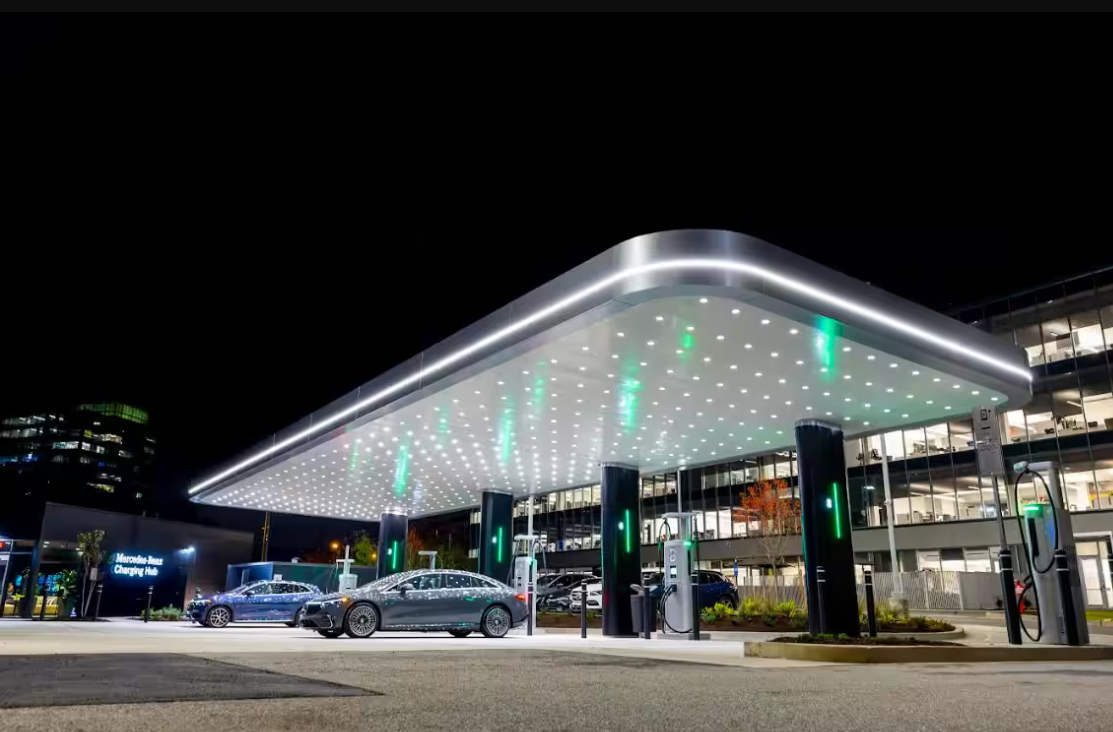
Electric vehicle charging is different from refueling a gasoline car. Instead of visiting a gas station whenever the tank is nearly empty, EV drivers can charge at home, at work, in public parking areas, or at fast-charging stations along highways.
The right charging option depends on how far you drive, where you park, how quickly you need to recharge, and which charging connectors your vehicle supports. Some drivers can meet most of their needs with a household outlet, while others benefit from a dedicated home charger and occasional public fast charging.
This EV charging guide explains how electric vehicle charging works, the differences between charging levels, how to estimate charging time and costs, and what to know before using a public charging station in the United States.
How Does Electric Vehicle Charging Work?
An electric vehicle stores energy in a rechargeable battery. When you connect the car to a compatible power source, electricity flows through the charging equipment into the vehicle.
There are two main ways to charge a plug-in vehicle: alternating current (AC) charging and direct current (DC) charging.
AC charging is commonly used at home, at workplaces, and at public destination chargers. The vehicle’s onboard charger converts incoming AC electricity into DC electricity that the battery can store.
DC fast charging uses equipment that converts electricity to DC outside the vehicle. This allows compatible vehicles to receive power without relying on their onboard AC charger for that conversion, enabling much faster charging.
The charging equipment, vehicle battery, onboard systems, and available electrical power all influence the rate of charging. A charger with a high advertised power rating does not guarantee that every vehicle will charge at that speed.
Understanding the Three Main EV Charging Levels
In the United States, EV charging is commonly divided into Level 1, Level 2, and DC fast charging. Each option serves a different purpose.
| Charging type | Typical power supply | Indicative charging performance | Common use |
|---|---|---|---|
| Level 1 | 120-volt AC | Around 3–5 miles of range per hour | Home charging, short daily commutes |
| Level 2 | 208–240-volt AC, depending on location | Around 25–40 miles of range per hour | Home, workplace, and destination charging |
| DC fast charging | High-power DC equipment | Can add substantial range in a short stop | Road trips and rapid public charging |
These range estimates are illustrative U.S. EPA figures, not guaranteed charging rates. Actual results vary by vehicle efficiency, charger output, battery condition, and operating temperature.
Level 1 Charging
Level 1 charging uses a standard 120-volt household outlet and compatible charging equipment. Many drivers can use a portable charging cord supplied with their vehicle, although included equipment varies by model.
Its main advantage is convenience. If your vehicle is parked overnight and you drive relatively few miles per day, Level 1 may replenish enough energy for your ordinary routine without requiring a dedicated charging installation.
The drawback is its slow charging speed. Drivers who travel long distances every day or need to replenish a large amount of energy between consecutive trips may find it insufficient.
Before using a household outlet for regular charging, check that the outlet and circuit are suitable for the sustained electrical load. A plug fitting into an outlet does not, by itself, establish that the installation is safe.
Level 2 Charging
Level 2 charging uses higher-voltage AC electricity. At home in the United States, this commonly involves a 240-volt circuit and a dedicated charging unit.
Level 2 can replenish substantially more range during the same parking period than Level 1. That makes it useful for longer commutes, larger battery-electric vehicles, and households that want more flexibility between trips.
Level 2 chargers are available at homes, workplaces, shopping destinations, parking garages, and other locations where vehicles stay parked for a while.
For home installation, a qualified electrician should assess the electrical panel, circuit capacity, wiring, and applicable permit requirements. The cost and complexity depend on the property and the equipment selected.
DC Fast Charging
DC fast charging is designed for drivers who need to replenish a battery quickly, particularly during long-distance travel.
These stations are commonly located along major highways, in travel centers, and at other public charging locations. Depending on the vehicle and station, charging from a low battery level to approximately 80% may take around 20 minutes to an hour. That is a broad reference range, not a promise for every model.
Charging usually slows as the battery approaches a high state of charge. Battery temperature, vehicle charging limits, station output, and power sharing between charging stalls can also affect performance.
Most plug-in hybrids do not support DC fast charging. Check your owner’s manual before planning a trip around this charging method.
Where Can You Charge an Electric Car?
Most EV drivers combine different charging options according to their daily routines. The most practical setup depends on home parking, workplace access, and the availability of public charging along frequently traveled routes.
Charging at Home
Home charging allows you to recharge while your vehicle is parked overnight or during other periods when it is not being used.
A suitable Level 1 outlet may be enough for some drivers. Others may benefit from installing a Level 2 charger to accommodate longer commutes, larger batteries, or tighter charging schedules.
Home charging can offer predictable costs because you can calculate electricity expenses using your utility’s applicable rate. Some electricity providers also offer time-of-use plans that charge different rates at different times of day.
Before installing a charger, consider the equipment price, electrical work, permits, ongoing electricity costs, and whether you have permission to install charging equipment at your property.
Workplace Charging
Workplace charging can help drivers replenish their vehicles while they are at the office.
Level 2 equipment is often suited to workplaces because vehicles may remain parked for several hours. Availability, fees, parking restrictions, and charging time limits depend on the employer and property operator.
Workplace charging can supplement home charging or provide an alternative for people whose residential parking does not support a private charger.
Public Destination Charging
Destination chargers are installed at places where drivers already spend time, such as hotels, shopping centers, public parking facilities, and entertainment venues.
These are often Level 2 chargers. They are most useful when the vehicle can remain parked long enough to receive a meaningful charge.
Some destinations provide charging as a customer amenity, while others charge separately for electricity or parking. Check the station’s terms rather than assuming charging is free.
Public DC Fast Charging
Public DC fast chargers are useful when you need more range during a road trip or cannot wait several hours to recharge.
Before setting off, plan suitable charging stops and check the connectors supported by your vehicle. Where possible, confirm the station’s current availability, power rating, pricing, and access conditions.
The U.S. Department of Energy’s Alternative Fueling Station Locator can help you find stations by location, charging level, and other filters. Because station information can change, verify critical details with the charging network before relying on a particular stop.
EV Charging Connectors Explained
Connector compatibility is one of the most important things to understand before using public charging equipment. A station can have the right charging speed but still be unsuitable for your vehicle if the connection is incompatible.
The main connector types you may encounter in the United States include the following.
| Connector | Typical application | What to know |
|---|---|---|
| SAE J1772 | AC Level 1 and Level 2 | Widely used for AC charging on many EVs |
| SAE J3400 / NACS | AC and DC charging | A connector standard based on the North American Charging Standard |
| CCS1 | DC fast charging | Combines the J1772 AC interface with additional DC contacts |
| CHAdeMO | DC fast charging | Found on some vehicles, including certain older models |
J1772 and J3400/NACS
J1772 is a common AC charging connector in the U.S. market. SAE J3400, associated with NACS, supports both AC and DC charging using one connector design.
Vehicle connector adoption has been changing as manufacturers introduce newer models and compatible charging access. Therefore, do not rely solely on the brand name or the vehicle’s model year to determine which stations it can use.
CCS1 and CHAdeMO
CCS1 is a DC fast-charging connector that incorporates the J1772 AC interface along with additional contacts for DC power.
CHAdeMO is another DC fast-charging connector, found on certain vehicle models and charging stations.
Not every charging site supports every connector type. Check the vehicle inlet, station connector, and any adapter requirements before beginning a charging session.
Do You Need an Adapter?
Sometimes. An adapter can allow a vehicle to connect to compatible equipment that uses a different connector, but compatibility depends on the specific vehicle, adapter, charging direction, and station.
An adapter that works for AC charging does not necessarily support DC fast charging. Some networks may also require vehicle authorization, software support, or other conditions.
Use only an adapter approved for the intended equipment and charging application. Confirm compatibility with the vehicle manufacturer and charging network instead of assuming that a physically fitting plug will work safely.
How Long Does It Take to Charge an Electric Car?
EV charging time depends on several factors, so two vehicles connected to chargers with the same advertised power may charge at different rates.
The most important factors are:
- Battery capacity: Larger batteries generally require more energy to charge.
- Starting charge level: Charging from a low battery level requires more energy than topping up.
- Charger power: Higher available power can reduce charging time when the vehicle can accept it.
- Vehicle charging limits: The vehicle may be unable to use the charger’s maximum output.
- Battery temperature: Cold or hot conditions can affect charging performance.
- Battery state of charge: Many EVs reduce charging power as the battery approaches a high charge level.
Why Charging Speed Changes
Charging is not always a constant process. A vehicle may accept high power during part of a DC fast-charging session and then gradually reduce power as the battery fills.
This is one reason that an advertised peak charging rate does not tell you how long every charging session will take.
For road trips, consider the time needed to reach a useful charge level rather than assuming every stop must take the battery to 100%. The most efficient stopping strategy depends on your car, route, charger availability, and destination.
For more detailed comparisons, consult the manufacturer’s charging guidance for your exact vehicle.
How Much Does EV Charging Cost?
Electric vehicle charging costs vary according to electricity rates, charging location, station pricing, vehicle efficiency, and the amount of energy used.
Home charging is often economical for drivers with suitable residential parking, but the total cost depends on the utility tariff and any installation expenses. Public DC fast charging may cost more per unit of energy at some locations, although prices vary by network and location.
Calculate Your Home Charging Cost
A simple estimate uses the amount of electricity consumed and the applicable price per kilowatt-hour (kWh).
Charging cost = Electricity consumed (kWh) × Electricity price ($/kWh)
For example, suppose a charging session draws 30 kWh from your home’s electrical supply and your electricity rate is $0.16 per kWh.
30 kWh × $0.16 = $4.80
This is an illustrative example, not a national electricity rate. Actual electricity rates differ by utility, location, time of day, and rate plan. Energy drawn from the grid may also exceed the amount ultimately stored in the battery because charging involves energy losses.
Compare Energy Cost per Mile
You can also estimate charging expenses per 100 miles.
Suppose a vehicle uses 30 kWh of electricity per 100 miles and your electricity rate is $0.16 per kWh.
30 kWh × $0.16 = $4.80 per 100 miles
This example allows you to compare energy costs using consistent assumptions. Your actual results will depend on the vehicle’s efficiency, driving conditions, and electricity rate.
Understand Public Charging Fees
Public charging networks may bill by the amount of electricity delivered, the duration of a session, or another pricing structure permitted in the applicable location. Some stations also have session fees, parking charges, or idle fees when a vehicle remains connected after charging finishes.
Before starting, check the displayed rate, any applicable membership or subscription terms, and whether parking or idle fees may apply.
A charging network’s mobile app or website may provide pricing and station information. Payment methods vary by station, so check the available payment options before you arrive.
How to Charge an EV at a Public Station
The exact steps depend on the charger and charging network, but the general process is straightforward.
- Find a compatible station. Check the connector type, charging level, location, and vehicle compatibility.
- Check availability and pricing. Review station status, charging rates, and any restrictions or additional fees.
- Park in the designated space. Position your vehicle so the charging cable can reach its inlet without stretching or creating a hazard.
- Follow the station’s instructions. Depending on the equipment, you may need to authenticate through an app, an RFID card, a payment card, or another supported method.
- Connect the cable. Plug in the connector and follow the vehicle and station prompts to start charging.
- Confirm that charging has started. Check the station display or vehicle dashboard for the charging status.
- End the session correctly. Use the station’s instructions to stop charging, unlock the connector if necessary, and return the cable.
- Move your vehicle when finished. Avoid occupying a charging space longer than necessary, particularly where idle or parking fees apply.
If the session fails to start, check the displayed instructions and connection status. If the charger reports a fault, stop using it and contact the network operator rather than attempting electrical repairs yourself.
EV Charging Safety and Etiquette
Safe charging requires compatible equipment, proper usage, and attention to the condition of cables and connectors.
For home charging, use suitable equipment and follow the manufacturer’s instructions. Have a qualified electrician assess installations requiring electrical work. For public charging, do not use visibly damaged connectors or cables, and report faulty equipment to the operator.
Outdoor charging can be appropriate when the vehicle and charging equipment are designed for the conditions and installed according to their instructions. Protect the cable from physical damage and avoid using unsuitable extension cords or improvised adapters.
Good charging etiquette also helps everyone access public charging more easily:
- Use a charging station only when your vehicle is compatible.
- Avoid occupying a charging space after your session has finished.
- Do not disconnect another vehicle unless the equipment and applicable rules explicitly permit it.
- Return charging cables and connectors to their holders.
- Respect parking limits and station-specific instructions.
For more information about home installation and equipment, consult the U.S. Department of Energy’s guide to charging electric vehicles at home.
How to Choose the Right EV Charging Option
There is no single charging setup that is best for every electric vehicle owner. The most suitable option depends on daily mileage, parking access, the vehicle’s charging capabilities, and how often you take longer trips.
Use the following practical framework:
| Your situation | Charging approach to consider |
|---|---|
| Short daily commute and overnight parking | Level 1 may be sufficient |
| Longer daily commute or larger battery | Consider home Level 2 charging |
| Workplace parking for several hours | Workplace Level 2 charging may help |
| Shopping, dining, or hotel stops | Destination charging may fit your routine |
| Long-distance highway travel | Plan compatible DC fast-charging stops |
| Apartment without private charging | Explore shared, workplace, and nearby public charging |
Before purchasing a charger, verify the vehicle’s connector, maximum AC charging power, and any adapter requirements. If you plan to install home equipment, include electrical assessment, installation, and permitting in your budget.
The best system is one that meets your normal driving needs while giving you a practical backup plan for longer trips.
Frequently Asked Questions About EV Charging
What is the best way to charge an electric car?
For drivers with suitable home parking, overnight charging with Level 1 or Level 2 equipment can be convenient. Public DC fast charging is more useful when rapid charging is needed during longer trips. The best approach depends on daily mileage, vehicle compatibility, charging access, and budget.
Is Level 1 charging enough for an electric car?
It can be enough for drivers with short commutes and sufficient overnight parking time. Drivers who regularly cover longer distances may need Level 2 charging or access to public charging.
Is DC fast charging bad for an EV battery?
DC fast charging is a normal feature of compatible EVs, but repeated use, high temperatures, and charging habits can affect battery aging differently depending on the vehicle and conditions. Follow your manufacturer’s guidance on fast charging, battery care, and recommended charge limits.
Should I charge my EV to 100% every day?
Not necessarily. Recommended charging targets vary by vehicle and battery design. Many EVs let owners set a daily charging limit and reserve a full charge for trips when extra range is useful. Consult the owner’s manual for guidance specific to your car.
Can all electric cars use DC fast charging?
No. DC fast charging capability depends on the vehicle. Most battery-electric vehicles support DC fast charging, but not every model or charging configuration does. Most plug-in hybrids do not support it either. Verify your vehicle’s specifications before planning a fast-charging stop.
Does every EV use the same charging connector?
No. Connector compatibility varies by vehicle and charging level. In the United States, J1772, J3400/NACS, CCS1, and CHAdeMO are among the connector types drivers may encounter. Adapters can provide compatibility in some cases, but not every adapter works for every charging application.
Is home charging cheaper than public charging?
It often can be, but not in every situation. Compare your residential electricity rate with the price at public stations, including membership costs, session fees, parking charges, and any applicable idle fees.
How do I find EV charging stations on a road trip?
Use a station locator or charging-network app to search along your route. Filter by charging level and connector type, then confirm station status, pricing, and access information before departing. Plan alternatives for important stops in case a charger is unavailable.
Final Thoughts
Understanding EV charging makes it easier to choose the right equipment, manage charging costs, and plan everyday driving or longer journeys.
Level 1 and Level 2 charging can support many daily routines, while DC fast charging provides a faster option for compatible vehicles on longer trips. Connector compatibility, charging speed, electricity rates, and station access all matter when deciding how to charge.
Start by checking your vehicle’s capabilities and your regular parking arrangements. Then choose the charging options that meet your needs, verify costs before charging, and plan ahead for trips that require public stations.
Sources and Further Reading
- U.S. EPA — Charging My Electric Vehicle
- U.S. EPA — Getting Started with Home EV Charging
- U.S. Department of Transportation — Charger Types and Speeds
- U.S. Department of Energy — Charging Electric Vehicles at Home
- U.S. Department of Energy — Electric Vehicle Charging Stations
- Joint Office of Energy and Transportation — SAE J3400 Charging Connector